Fig. 8.1 shows a tube in which X-rays are produced at a metal target. Particles are accelerated from the filament to the target by a constant high voltage applied across the terminals X and Y.
(b)(i)State the name of the particles.
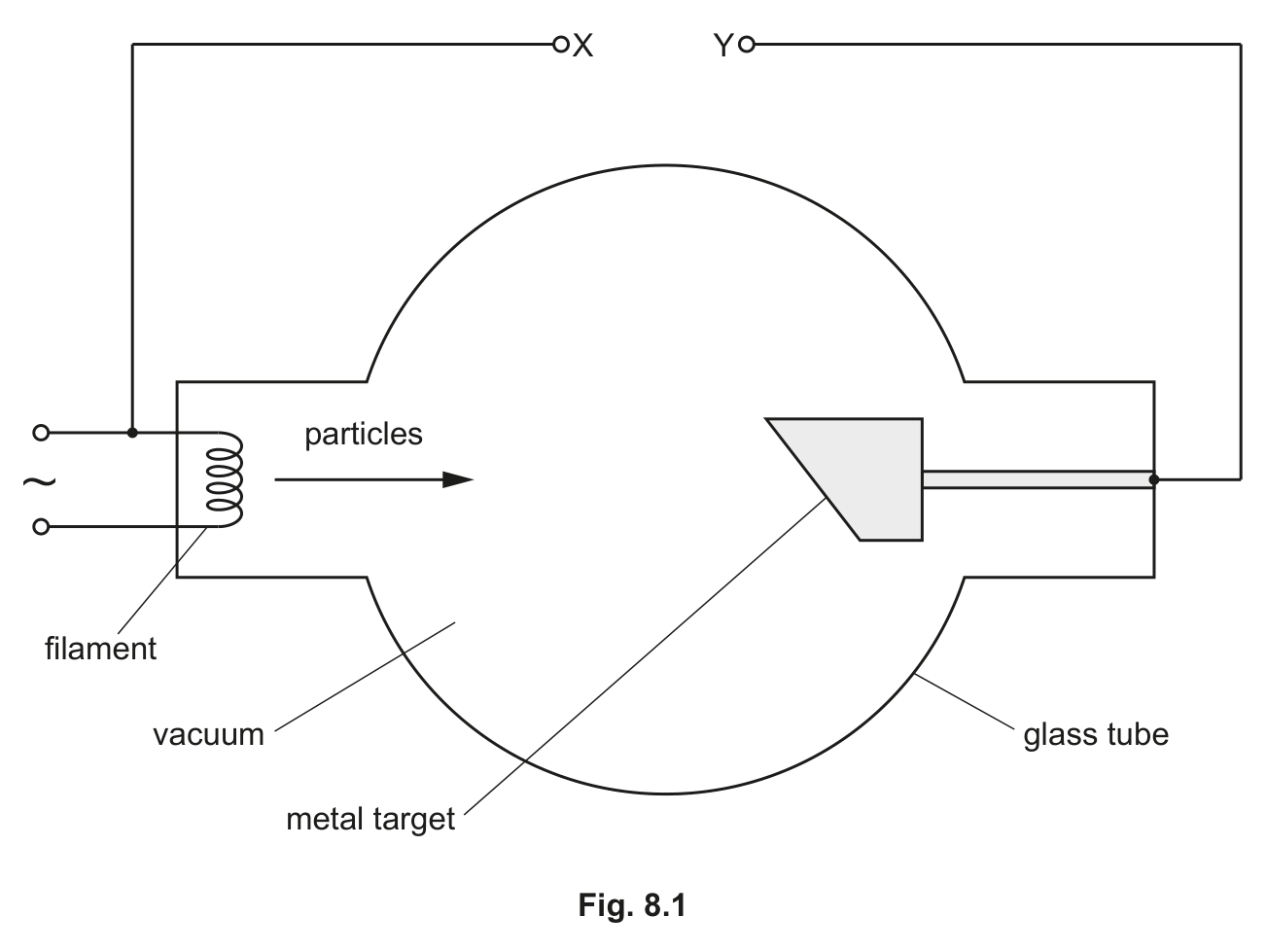
Fig. 8.1 shows a tube in which X-rays are produced at a metal target. Particles are accelerated from the filament to the target by a constant high voltage applied across the terminals X and Y.
(b)(i)State the name of the particles.
In an X-ray tube, particles are accelerated from a heated filament to a metal target by a constant high voltage applied across terminals X and Y, where X is connected to the filament side and Y to the target side .
(b)(ii)On Fig. 8.1, use + and – signs to label terminals X and Y to indicate the polarity of the high voltage.
(c)(i)In the X-ray tube of Fig. 8.1, electrons are accelerated from the filament to the metal target by a constant high voltage. For an accelerating voltage of 32 kV, determine the maximum energy, in MeV, of an X-ray photon produced at the target.
In the X-ray tube of Fig. 8.1, electrons are accelerated through a voltage of 32 kV onto a metal target.
(c)(ii)Determine the maximum momentum of an X-ray photon produced at the target.
(c)(iii)Determine the minimum wavelength of X-rays produced at the target.
(d)Explain why X-rays can be used to produce images of internal body structures that have good contrast.
9702/41/M/J/24Cambridge International AS & A Level Physics 9702 · May/June 2024 · Paper 4 variant 1 · Question 8