Available practice: 94 of 100 marks. Parts 3(a)(i), 7(a), 8(a) await marking support. Scores cover available parts only.
(a)Define electric field.
[2 marks]
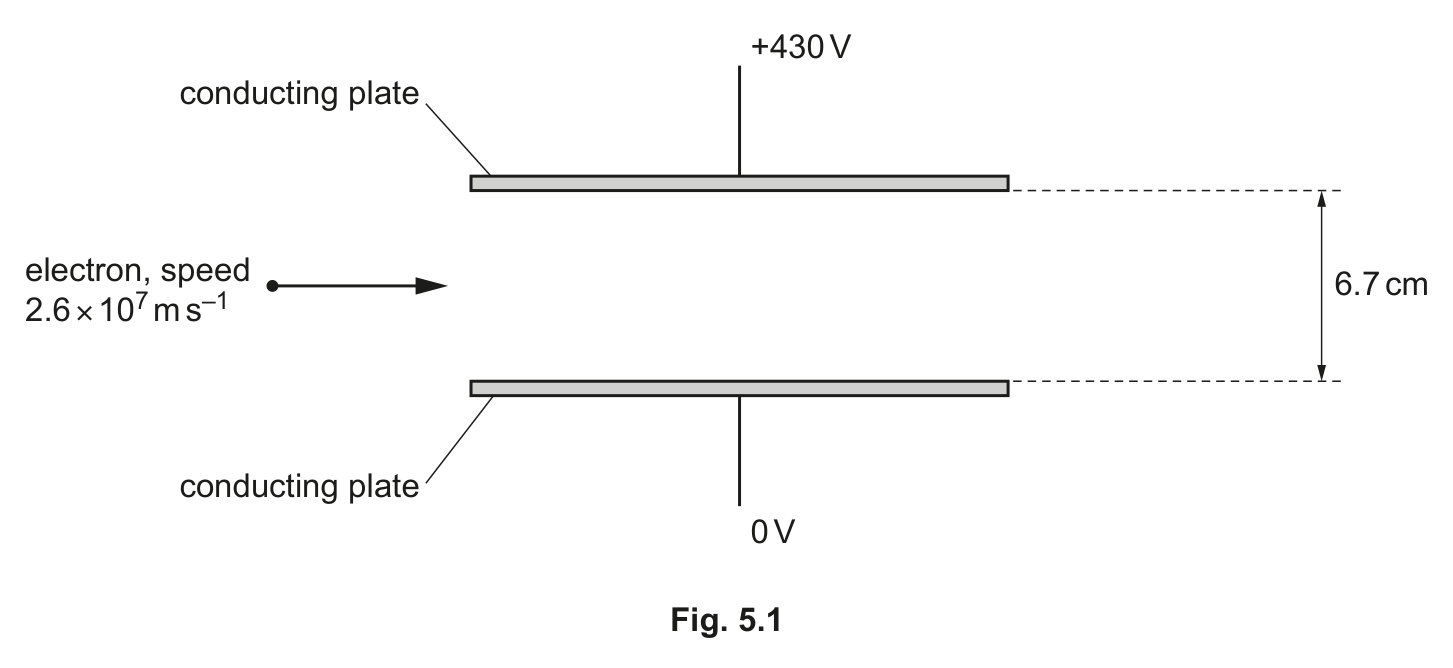
Fig. 5.1 shows two parallel conducting plates that are in a vacuum. The plates are separated by a distance of 6.7 cm and have a potential difference (p.d.) of 430 V between them.
(b)(i)On Fig. 5.1, draw four field lines to represent the electric field between the plates.
[2 marks]
Two parallel conducting plates in a vacuum are separated by a distance of 6.7 cm and have a potential difference of 430 V between them (upper plate at +430 V, lower plate at 0 V) .
(b)(ii)Determine the strength E of the electric field between the plates.
Answer guidance
Determine Work it out from what you are given or from the figure, and show how you got there.
[2 marks]
Two parallel conducting plates in a vacuum are separated by 6.7 cm with the upper plate at +430 V and the lower plate at 0 V. An electron travels at a speed of 2.6 × 10⁷ m s⁻¹ towards the region between the plates, entering horizontally midway between them, as shown in Fig. 5.1.
(b)(iii)On Fig. 5.1, draw the path of the electron as it moves between and beyond the plates.
[2 marks]
An electron travelling at 2.6 × 10⁷ m s⁻¹ enters horizontally midway between two parallel plates 6.7 cm apart, with the upper plate at +430 V and the lower plate at 0 V . A uniform magnetic field is now applied in the region of the electric field, so that the electron travels undeviated through the region.
(c)(i)Determine the direction of the uniform magnetic field.
Answer guidance
Determine Work it out from what you are given or from the figure, and show how you got there.
[1 mark]
An electron travelling at 2.6 × 10⁷ m s⁻¹ passes between two parallel plates 6.7 cm apart with a p.d. of 430 V between them. A uniform magnetic field is applied in the region of the electric field so that the electron travels undeviated through the region.
(c)(ii)Explain, with reference to the forces exerted by the two fields on the electron, why the path of the electron is undeviated.
Answer guidance
Explain Give reasons, not just what happens. Each distinct reason is usually worth a mark.
[2 marks]
An electron travelling at 2.6 × 10⁷ m s⁻¹ passes between two parallel plates separated by 6.7 cm with a p.d. of 430 V between them, and a uniform magnetic field is applied so that the electron travels undeviated.
(c)(iii)Determine the flux density B of the uniform magnetic field. Give a unit with your answer.
Answer guidance
Determine Work it out from what you are given or from the figure, and show how you got there.
[2 marks]
9702/41/M/J/24Cambridge International AS & A Level Physics 9702 · May/June 2024 · Paper 4 variant 1 · Question 5