Available practice: 94 of 100 marks. Parts 3(a)(i), 7(a), 8(a) await marking support. Scores cover available parts only.
(a)Define gravitational potential at a point.
[2 marks]
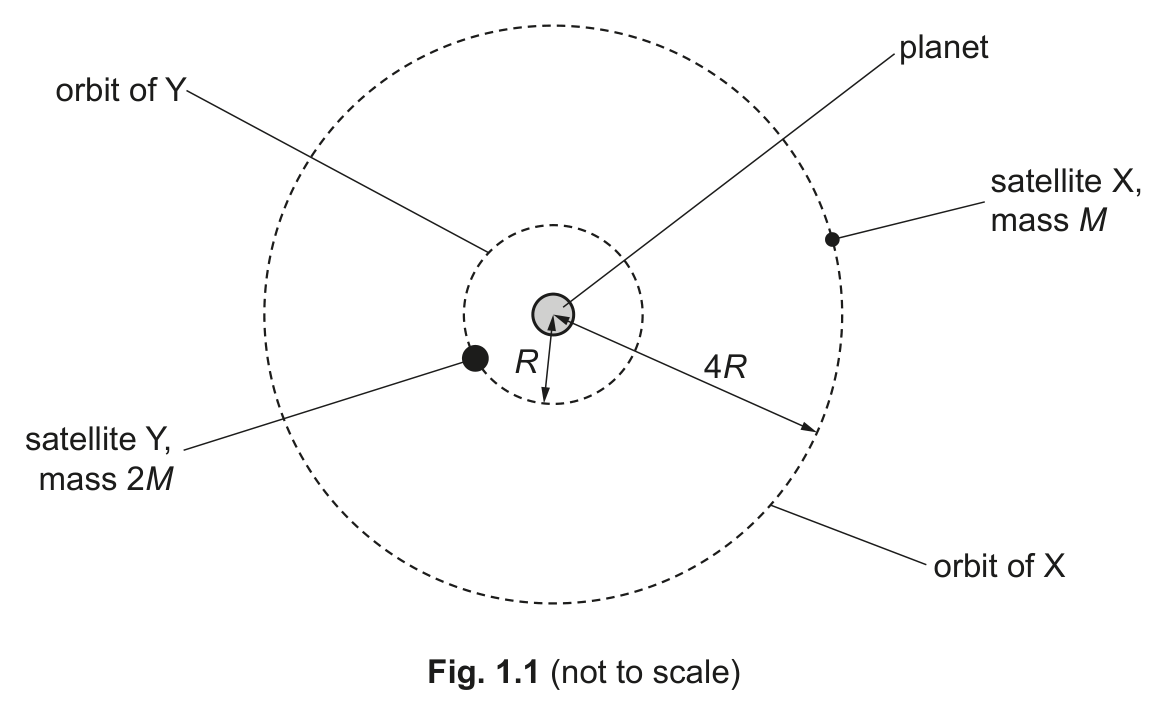
A satellite X, of mass M, orbits a planet at a constant distance 4R from the centre of the planet, as shown in Fig. 1.1. A second satellite Y, of mass 2M, orbits the planet with orbital radius R. The gravitational potential at X due to the planet is −Φ. The planet is a uniform sphere.
(b)(i)Explain why the gravitational potential at X is negative.
Answer guidance
Explain Give reasons, not just what happens. Each distinct reason is usually worth a mark.
[2 marks]
A satellite X, of mass M, orbits a planet at a constant distance 4R from the centre of the planet. A second satellite Y, of mass 2M, orbits the planet with orbital radius R. The gravitational potential at X due to the planet is −Φ. The planet is a uniform sphere.
(b)(ii)State an expression, in terms of Φ, for the gravitational potential at Y due to the planet.
Answer guidance
State A short answer. No explanation is needed, and adding one cannot earn extra marks.
[2 marks]
A satellite X, of mass M, orbits a planet at a constant distance 4R from the centre of the planet; a second satellite Y, of mass 2M, orbits the planet with orbital radius R. The gravitational potential at X due to the planet is −Φ. The planet is a uniform sphere.
(b)(iii)Complete Table 1.1 by giving expressions, in terms of some or all of M, R and Φ, for the quantities indicated for each of the satellites X and Y.
Answer guidance
Complete Fill in every gap. A partly completed answer usually scores partly.
[4 marks]
9702/41/M/J/24Cambridge International AS & A Level Physics 9702 · May/June 2024 · Paper 4 variant 1 · Question 1