2024 · M/J · 5054/41 | Q2

0/26parts marked · 0 of 40 marks
All questions
Question (2 of 4)10 marks · Practise this topic →
Options

Report Wrong question content

CIE-5054-2024-MJ-p41 · Question 2

Alternative to Practical: use the supplied data. Print measurement diagrams at the width stated in the question; screen previews resize them. Upload graphs and the readings used.

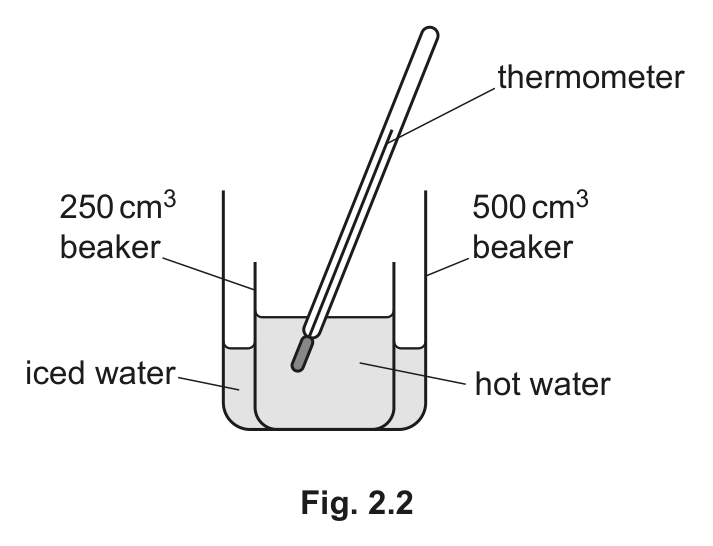
A student investigates how the temperature of the surroundings affects the rate of cooling of water. Start with approximately 100 cm³ of hot water in a 250 cm³ beaker. The initial thermometer reading is shown in Fig. 2.1.

Table 2.1 gives time t / s and temperature θ / °C: (0, your Fig. 2.1 reading), (30, 69), (60, 67), (90, 66), (120, 65), (150, 64), (180, 63), (210, 62), (240, 61).

(a)(i)Record the initial temperature in Table 2.1.
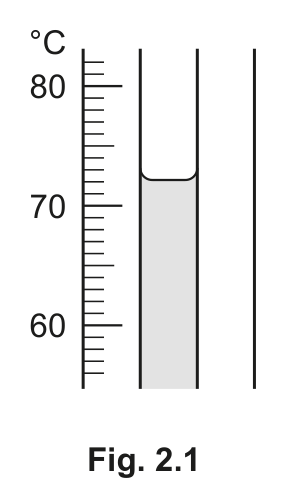
Fig. 2.1 — see the question text for what it shows
[1 mark]

(a)(ii)Explain why the water is carefully stirred before each temperature reading.

Answer guidance

Explain Give reasons, not just what happens. Each distinct reason is usually worth a mark.

[1 mark]

(a)(iii)Calculate average cooling rate C₁ during the first 90 s, using C₁ = (θ₀ − θ₉₀)/90. Give the unit.

Answer guidance

Calculate Show your working. The method can earn marks even when the final value is wrong, and a bare answer often cannot.

[2 marks]

(a)(iv)Calculate average cooling rate C₂ during the final 90 s, using C₂ = (θ₁₅₀ − θ₂₄₀)/90. Give the unit.

Answer guidance

Calculate Show your working. The method can earn marks even when the final value is wrong, and a bare answer often cannot.

[1 mark]

(a)(v)Compare C₁ and C₂ and explain any difference.

Answer guidance

Compare Say something about both, and make the comparison explicit rather than leaving it implied.

[1 mark]

Repeat with 100 cm³ of hot water in the smaller beaker placed carefully inside a larger beaker containing 100 cm³ of iced water. Do not mix the water between beakers. The arrangement is shown in Fig. 2.2.

Table 2.2 gives time t / s and temperature θ / °C: (0, 75), (30, 68), (60, 62), (90, 57).

(b)(i)Calculate C₃ = (θ₀ − θ₉₀)/90 for the first 90 s. Give the unit.

Fig. 2.2 — see the question text for what it shows
Answer guidance

Calculate Show your working. The method can earn marks even when the final value is wrong, and a bare answer often cannot.

[1 mark]

(b)(ii)Describe how C₃ differs from C₁. Explain your answer.

Answer guidance

Explain Give reasons, not just what happens. Each distinct reason is usually worth a mark.

[1 mark]

(b)(iii)By referring to the results in both tables, explain why this experiment is not a valid comparison of C₁ and C₃.

[1 mark]

(b)(iv)State one other variable that should be kept constant for a valid comparison.

Answer guidance

State A short answer. No explanation is needed, and adding one cannot earn extra marks.

[1 mark]

5054/41/M/J/24Cambridge O Level Physics 5054 · May/June 2024 · Paper 4 variant 1 · Question 2