2024 · M/J · 5054/31 | Q2

0/26parts marked · 0 of 40 marks
All questions
Question (2 of 4)10 marks · Practise this topic →
Options

Report Wrong question content

CIE-5054-2024-MJ-p31 · Question 2

Practical test: laboratory apparatus, supervision and your own measurements are required. Do not invent observations. Upload clear working and graphs with the readings used.

Investigate how the temperature of the surroundings affects the rate of cooling of water. Start with approximately 100 cm³ of hot water in a 250 cm³ beaker. A supervisor supplies the hot water. You also have a stopwatch, larger 500 or 600 cm³ beaker, thermometer, ice and water, and paper towels. Use your own measurements.

(a)(i)Measure the temperature θ, start the stopwatch immediately and record the reading in Table 2.1 at t = 0 s.

Answer guidance

Using You must use the thing it names. An answer that reaches the right value another way may not score.

[1 mark]

This part can’t be checked automatically, and its answer is your own measurement, so there is no explanation for it.
(a)(ii)Record temperature θ / °C in Table 2.1 at t / s = 0, 30, 60, 90, 120, 150, 180, 210, 240. Empty the beaker afterwards.

Answer guidance

Using You must use the thing it names. An answer that reaches the right value another way may not score.

[1 mark]

This part can’t be checked automatically, and its answer is your own measurement, so there is no explanation for it.

Use your readings in Table 2.1 at 30 s intervals from 0 to 240 s.

(a)(iii)Calculate average cooling rate C₁ during the first 90 s, using C₁ = (θ₀ − θ₉₀)/90. Give the unit.

Answer guidance

Calculate Show your working. The method can earn marks even when the final value is wrong, and a bare answer often cannot.

[2 marks]

This part can’t be checked automatically yet. Compare your own working with the explanation below.

Show explanationHide explanation

One correct answer. This part can’t be checked automatically yet, so compare your own working with it.

Take θ0, your reading at t = 0 s, and θ90, your reading at t = 90 s, from Table 2.1. Subtract the later temperature from the first, so the drop is positive: θ0 − θ90. Then divide by t = 90 s. The first mark is for this calculation done correctly with your own readings.

The second mark is for the unit. A temperature change in °C divided by a time in s gives °C/s (also written °C s⁻¹). Write it in the unit space; leaving it out loses that mark even if the number is right.

Do similar questions

(a)(iv)Calculate average cooling rate C₂ during the final 90 s, using C₂ = (θ₁₅₀ − θ₂₄₀)/90. Give the unit.

Answer guidance

Calculate Show your working. The method can earn marks even when the final value is wrong, and a bare answer often cannot.

[1 mark]

This part can’t be checked automatically yet. Compare your own working with the explanation below.

Show explanationHide explanation

One correct answer. This part can’t be checked automatically yet, so compare your own working with it.

Use θ150, your reading at t = 150 s, and θ240, your reading at t = 240 s, from Table 2.1. Work out θ150 − θ240 and divide by t = 90 s, the time between those two readings (240 s − 150 s). The mark is for this calculation done correctly from your own readings.

Give the unit as in (iii), °C/s. There is no separate unit mark here, and the scheme's general rules say a missing or wrong unit normally costs the calculation mark when no separate mark is given for it.

Do similar questions

(a)(v)Compare C₁ and C₂ and explain any difference.

Answer guidance

Compare Say something about both, and make the comparison explicit rather than leaving it implied.

[1 mark]

This part can’t be checked automatically yet. Compare your own working with the explanation below.

Show explanationHide explanation

One correct answer. This part can’t be checked automatically yet, so compare your own working with it.

Compare the two values you calculated. The scheme credits stating that C1 is greater than C2: the water cooled faster in the first 90 s than in the final 90 s.

Explain it using the temperature of the room. At the start the water is much hotter than its surroundings, so its temperature falls quickly. As it cools towards room temperature, the temperature drops less in each 90 s, so the average cooling rate is smaller. Give both the comparison and this reason for the mark.

Do similar questions

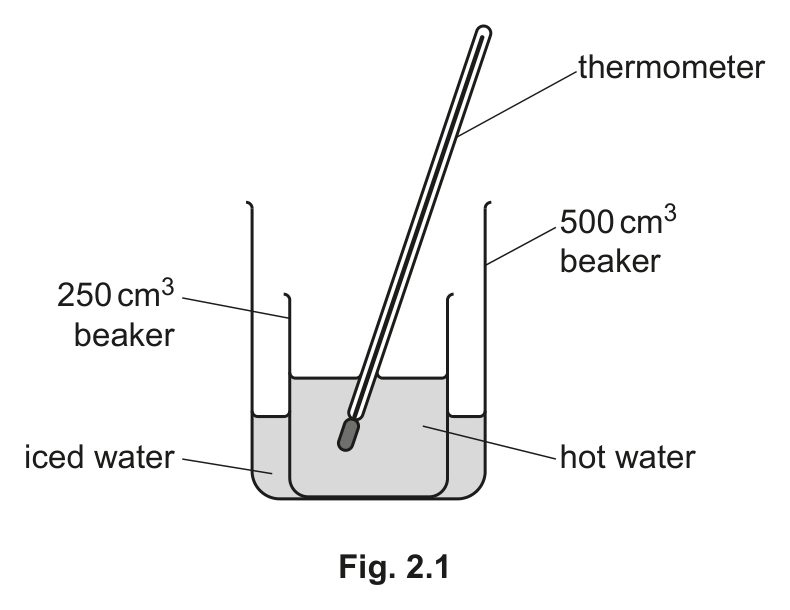
Repeat with 100 cm³ of hot water in the smaller beaker placed carefully inside a larger beaker containing 100 cm³ of iced water. Do not mix the water between beakers. The arrangement is shown in Fig. 2.1.

(b)(i)Measure the initial temperature of the hot water and start the stopwatch. Record Table 2.2 temperatures θ / °C at t / s = 0, 30, 60, 90, 120.

Fig. 2.1 — see the question text for what it shows
Answer guidance

Using You must use the thing it names. An answer that reaches the right value another way may not score.

[1 mark]

This part can’t be checked automatically, and its answer is your own measurement, so there is no explanation for it.

(b)(ii)Use Table 2.2 to calculate C₃ = (θ₀ − θ₉₀)/90. Give the unit.

Answer guidance

Using You must use the thing it names. An answer that reaches the right value another way may not score.

[1 mark]

This part can’t be checked automatically yet. Compare your own working with the explanation below.

Show explanationHide explanation

One correct answer. This part can’t be checked automatically yet, so compare your own working with it.

Use your own readings from Table 2.2, not Table 2.1. Take θ0, the temperature you recorded at t = 0 s, and θ90, the temperature at t = 90 s. Subtract to find the temperature drop, θ0 − θ90, then divide by the time taken, t = 90 s: C3 = (θ0 − θ90) ÷ 90.

A cooling rate is a temperature change per unit time, so its unit is °C/s (degrees Celsius per second). Write it in the unit space: the mark is for a correct calculation from your own readings, and a missing or wrong unit normally means the calculation mark is not given.

Do similar questions

(b)(iii)Describe how C₃ differs from C₁. Explain your answer.

Answer guidance

Explain Give reasons, not just what happens. Each distinct reason is usually worth a mark.

[1 mark]

This part can’t be checked automatically yet. Compare your own working with the explanation below.

Show explanationHide explanation

One correct answer. This part can’t be checked automatically yet, so compare your own working with it.

Compare your value of C3 with your value of C1 from (a)(iii). Both are average cooling rates over the first 90 s, but in (b) the beaker of hot water stood in iced water instead of in the room air. The mark scheme expects you to state that C3 is greater than C1: the water cooled faster with iced water around it.

Then give the reason: the iced water around the beaker is at a much lower temperature than the room air, so more energy is transferred from the hot water to these colder surroundings each second. The single mark needs both the comparison and this reason; stating which is bigger without explaining why is not enough.

Do similar questions

(b)(iv)State one variable to keep constant for a valid comparison of C₁ and C₃.

Answer guidance

Using You must use the thing it names. An answer that reaches the right value another way may not score.

[1 mark]

This part can’t be checked automatically yet. Compare your own working with the explanation below.

Show explanationHide explanation

One correct answer. This part can’t be checked automatically yet, so compare your own working with it.

For a valid comparison of C1 and C3, the only thing that should change is what surrounds the beaker of hot water: room air in (a), a larger beaker of iced water in (b). Anything else that affects how fast the hot water cools must be kept the same.

Name one such variable. The mark scheme accepts the volume of hot water (about 100 cm³ each time), the position of the thermometer in the water, or the room temperature. Give one clear answer: if you list several, a wrong first answer, or one that contradicts another, can cost the mark.

Do similar questions

5054/31/M/J/24Cambridge O Level Physics 5054 · May/June 2024 · Paper 3 variant 1 · Question 2