2023 · Specimen · 5054/03 | Q3

0/21parts marked · 0 of 40 marks
All questions
Question (3 of 4)14 marks · Practise this topic →
Options

Report Wrong question content

CIE-5054-2023-SP-p03 · Question 3

Practical test: laboratory apparatus, supervision and your own measurements are required. Do not invent observations. Upload clear working and graphs with the readings used.

Investigate oscillations of masses attached to a metre rule. You have a metre rule, a G-clamp, stopwatch, small piece of wood to protect the scale, two 100 g masses, adhesive putty and a 30 cm ruler. Use your own measurements.

(a)(i)Fig. 3.1 identifies the diameter d and width w of a mass. Measure and record d and w for one of your masses, including units.
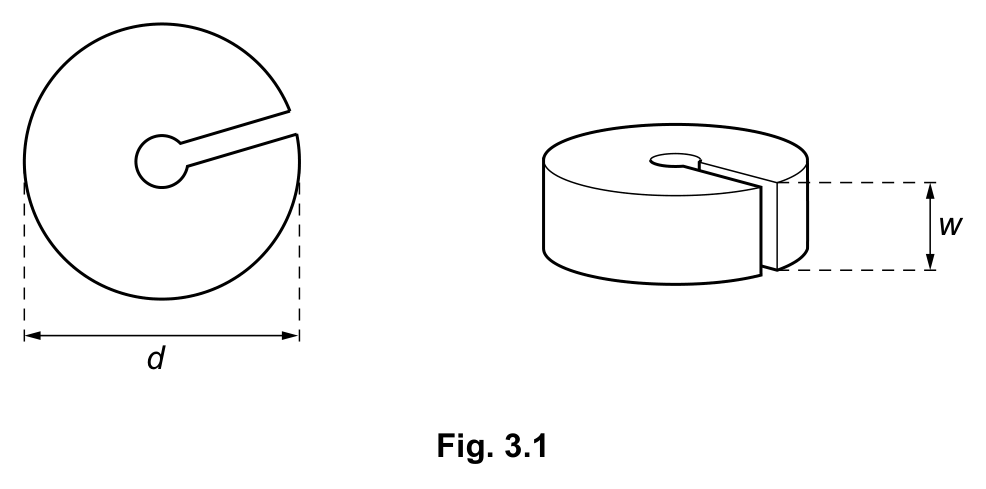
Fig. 3.1 — see the question text for what it shows
Answer guidance

Using You must use the thing it names. An answer that reaches the right value another way may not score.

[1 mark]

This part can’t be checked automatically yet. Compare your own working with the explanation below.

Show explanationHide explanation

One correct answer. This part can’t be checked automatically yet, so compare your own working with it.

Use the 30 cm ruler on one mass. Measure d as the widest distance straight across the circular face, and w as the thickness of the mass from its bottom face to its top face, as shown in Fig. 3.1.

Write a unit (mm or cm) in the unit space beside each value. The mark needs values for both d and w and a unit; values written without any unit do not earn it.

Do similar questions
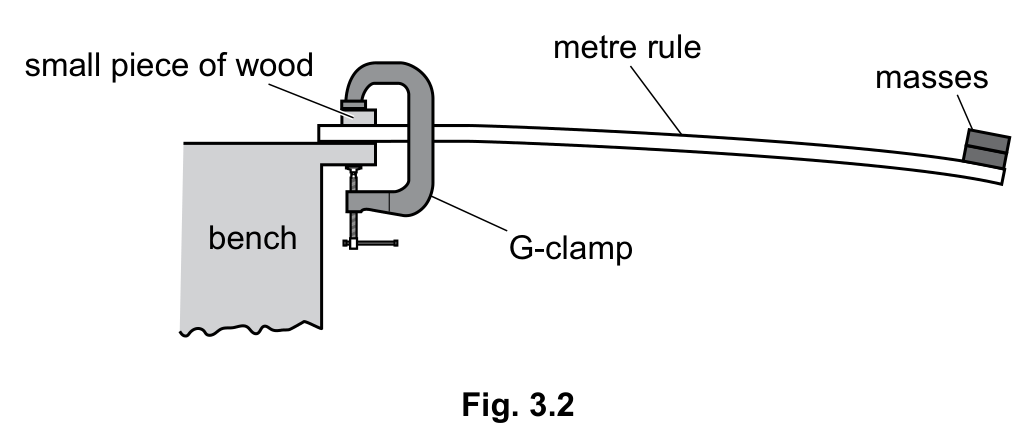
Attach the two masses together with putty. Set up Fig. 3.2 so that about 90 cm of the rule extends from the bench, with the masses secured to its end.

(a)(ii)Describe how to determine the position of the centre of the masses on the metre rule.

Fig. 3.2 — see the question text for what it shows
Answer guidance

Describe Say what happens, in order. Reasons are not required unless the question also asks why.

[1 mark]

This part can’t be checked automatically yet. Compare your own working with the explanation below.

Show explanationHide explanation

One correct answer. This part can’t be checked automatically yet, so compare your own working with it.

The masses are fixed at the very end of the metre rule, so their centre is half a diameter in from that end. Use your value of d from (a)(i): if the masses are at the zero end, the centre is at 0 + d/2 on the scale; if they are at the 100 cm end, it is at 100 − d/2. Make sure d is in cm before you add or subtract it.

Do similar questions

(a)(iii)Determine distance L along the rule from the edge of the bench to the point directly below the centre of the masses. Show your working and give L in cm.

Answer guidance

Show The result is given, so every step of the reasoning is what earns the marks.

[2 marks]

This part can’t be checked automatically yet. Compare your own working with the explanation below.

Show explanationHide explanation

One correct answer. This part can’t be checked automatically yet, so compare your own working with it.

Read the metre rule scale where it passes the edge of the bench, and take the scale position of the centre of the masses from (a)(ii). L is the difference between these two scale readings.

Write both raw readings in your working, each to the nearest mm, then subtract. Give L in cm to the nearest mm (one decimal place) with its unit. Read the scale with your eye directly above the bench edge to avoid parallax.

Do similar questions

Lift the free end until the rule is approximately horizontal, then release it. One oscillation is motion down and back to the starting position.

(b)(i)Determine time t for one oscillation. Show your working and give t in seconds.

Answer guidance

Show The result is given, so every step of the reasoning is what earns the marks.

[2 marks]

This part can’t be checked automatically yet. Compare your own working with the explanation below.

Show explanationHide explanation

One correct answer. This part can’t be checked automatically yet, so compare your own working with it.

Do not time a single oscillation. Release the rule from horizontal, start the stopwatch and time at least 10 complete oscillations, each one down and back up to the starting position. Write the number of oscillations and the total time in your working.

Divide the total time by the number of oscillations to get t, and give t in seconds to the nearest 0.01 s. Timing many oscillations makes your reaction time a much smaller fraction of the time you measure.

Do similar questions

(b)(ii)Repeat for four more values of L by moving the masses along the top of the rule and securing them with putty. Record all readings in Table 3.1, including appropriate column headings and units.

Answer guidance

Using You must use the thing it names. An answer that reaches the right value another way may not score.

[3 marks]

This part can’t be checked automatically yet. Compare your own working with the explanation below.

Show explanationHide explanation

One correct answer. This part can’t be checked automatically yet, so compare your own working with it.

Use the three columns for L, the total time you measured, and t for one oscillation. Head every column with the quantity and its unit, in the form L / cm, time for 10 oscillations / s and t / s (change 10 to however many you timed), or with the unit in brackets.

Record five sets of data: your first set from (a)(iii) and (b)(i) plus four more values of L. Spread the L values out by moving the masses towards the bench, but not below 40 cm. Each time, read the scale at one edge of the masses and add or subtract d/2 to find their centre; L is the difference between that and the bench-edge reading. Give L to the nearest mm and t to 0.01 s.

Check that the t column holds the time for one oscillation, worked out by dividing, not the total time. The scheme also needs the five sets to show the correct trend: t gets shorter as L is made shorter.

Do similar questions

(c)Explain why it is not practical to reduce L below 40 cm.

Answer guidance

Explain Give reasons, not just what happens. Each distinct reason is usually worth a mark.

[1 mark]

This part can’t be checked automatically yet. Compare your own working with the explanation below.

Show explanationHide explanation

One correct answer. This part can’t be checked automatically yet, so compare your own working with it.

With the masses close to the bench the rule oscillates much faster. The time for one oscillation becomes so short that you cannot count the oscillations with certainty, so your timings would not be repeatable. Say this: there are too many oscillations to count reliably, or the period is too short to count with repeatability.

Do similar questions

(d)Plot t on the y-axis against L on the x-axis using your readings in Table 3.1. You do not need to start from (0, 0). Draw the straight line of best fit. Use graph paper.

Answer guidance

Using You must use the thing it names. An answer that reaches the right value another way may not score.

[4 marks]

This part can’t be checked automatically yet. Compare your own working with the explanation below.

Show explanationHide explanation

One correct answer. This part can’t be checked automatically yet, so compare your own working with it.

Put L on the x-axis and t on the y-axis, and label both with the quantity, for example L / cm and t / s. Choose scales where each large square is 1, 2, 5 or 10 units (or these multiplied by a power of ten); avoid awkward scales such as 3 or 7 per square.

You need not start at zero, so begin each axis just below your smallest value. The scheme wants your plotted points to spread over at least 4 large squares across and 6 large squares up, with all five points plotted.

Plot each point within half a small square of its true position, using small neat crosses. Then draw one straight line of best fit with a ruler, with the points evenly spread above and below it. It does not have to pass through the origin or through any particular point.

Do similar questions

5054/03/SP/23Cambridge O Level Physics 5054 · Specimen 2023 · Paper 3 · Question 3