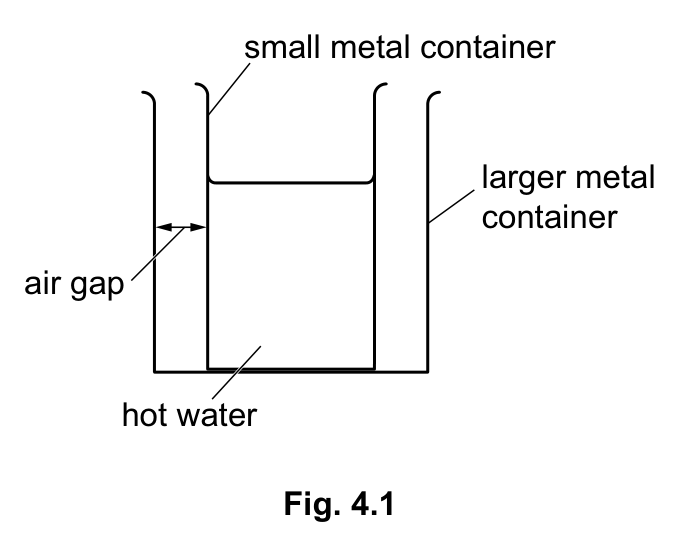
A student places a small metal container inside a larger metal container with an air gap between them, as shown in Fig. 4.1. The student investigates the effect of the size of this air gap on the rate of cooling of hot water.
Plan an experiment using a small metal container, larger metal containers of different diameters, a thermometer, a stopwatch, a measuring cylinder and a supply of hot water. You may also use other apparatus and materials usually available in a school laboratory. You are not required to carry out the investigation.
Explain briefly how to carry out the investigation; state the key variables to control; draw a table or tables with column headings and units (no readings required); explain how to use the readings to reach a conclusion. A diagram is optional.
This part can’t be checked automatically yet. Compare your own working with the explanation below.
Show explanationHide explanation
One correct answer. This part can’t be checked automatically yet, so compare your own working with it.
Use the measuring cylinder to put a fixed volume of hot water into the small metal container and stand it inside one of the larger containers. Use the thermometer and the stopwatch to find the time taken for the temperature to drop by a chosen amount (or the drop in temperature in a fixed time).
Repeat with at least three larger containers of different diameters, so the air gap changes, and record each air gap (for example, half the difference between the two diameters, with the small container centred). Keep the same volume of hot water, the same starting temperature and the same room temperature each time, and state at least two of these controls.
Draw a table with one column for the air gap, with its unit (cm or mm), and one for the time taken in s, or the temperature change in °C if you fixed the time. The columns must match the method you described.
Conclude that the air gap giving the shortest time for the chosen drop (or the greatest temperature change in the fixed time) has the greatest rate of cooling. Alternatively, record the temperature at regular times, plot temperature against time for each air gap, and the steepest gradient shows the greatest rate of cooling.
Do similar questions