As the ball oscillates, it touches each plate in turn.
(a)Referring to the charge on the ball, explain why the ball moves to the positive plate after touching the negative plate.
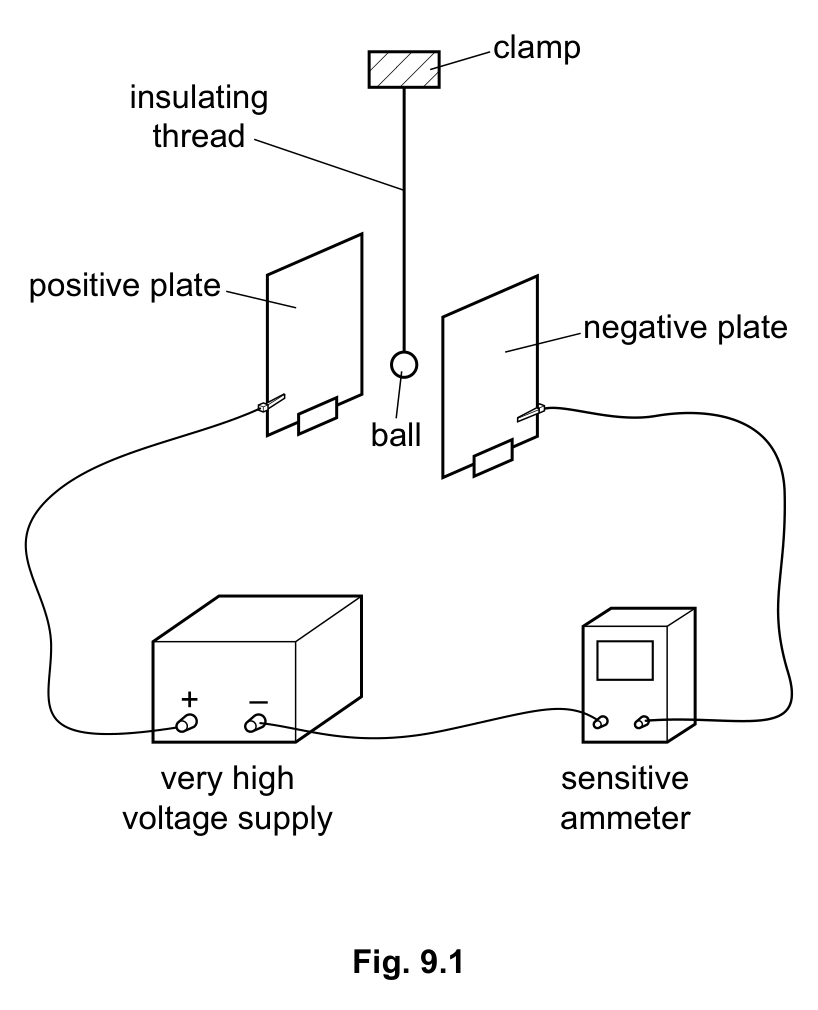
As the ball oscillates, it touches each plate in turn.
(a)Referring to the charge on the ball, explain why the ball moves to the positive plate after touching the negative plate.
(b)State which particles move when there is a current and state the direction in which they move through the sensitive ammeter.
A conducting ball oscillates between two charged plates connected to a sensitive ammeter. For each complete oscillation of the ball moving between the plates, a charge of 8.5 × 10⁻¹⁰ C is transferred from one plate to the other. The frequency of oscillation is 4.0 Hz.
(c)Calculate the current shown on the sensitive ammeter.
0625/04/SP/23Cambridge IGCSE Physics 0625 · Specimen 2023 · Paper 4 · Question 9