Available practice: 51 of 60 marks. Parts 1(a), 3(a), 6(d)(i), 6(d)(ii) await marking support. Scores cover available parts only.
(a)Define strain.
[1 mark]
A copper wire of length 4.0 m has a uniform cross-sectional area of 4.5 × 10⁻⁷ m². A tensile force of 18 N is applied to the wire. This causes the wire to extend by 1.4 mm up to its limit of proportionality.
(b)(i)Calculate the Young modulus of the wire.
Answer guidance
Calculate Show your working. The method can earn marks even when the final value is wrong, and a bare answer often cannot.
[3 marks]
A copper wire of length 4.0 m has a uniform cross-sectional area of 4.5 × 10⁻⁷ m². A tensile force of 18 N is applied to the wire, causing it to extend by 1.4 mm up to its limit of proportionality.
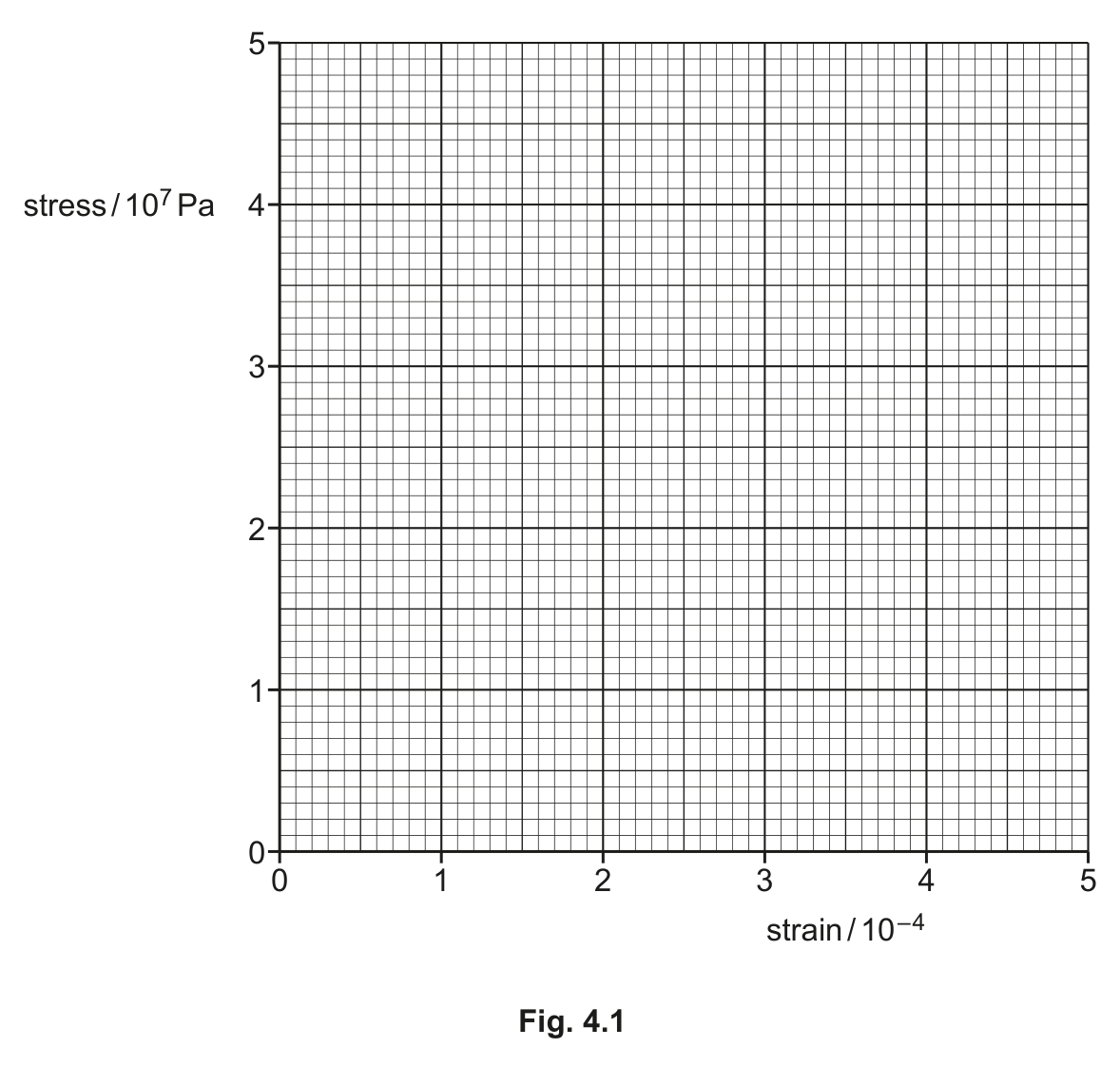
(b)(ii)On Fig. 4.1, draw a line to show how the stress varies with the strain for the wire up to its limit of proportionality.
[2 marks]
A copper wire of length 4.0 m has a uniform cross-sectional area of 4.5 × 10⁻⁷ m² and a tensile force of 18 N is applied to it. A second copper wire has the same length as this wire but a larger diameter. Both wires are subjected to a tensile force of 18 N.
(c)By placing a tick (✓) in each row, complete Table 4.1 to compare the stress and strain of the two wires.