Available practice: 51 of 60 marks. Parts 1(a), 3(a), 6(d)(i), 6(d)(ii) await marking support. Scores cover available parts only.
(a)State Kirchhoff's first law.
Answer guidance
State A short answer. No explanation is needed, and adding one cannot earn extra marks.
[1 mark]
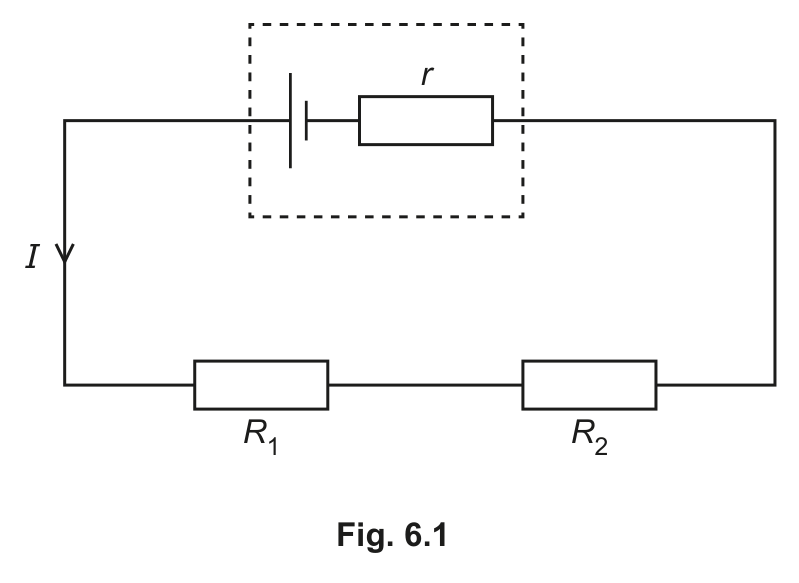
A cell with internal resistance r is connected to two resistors of resistances R₁ and R₂ as shown in Fig. 6.1.
The potential differences (p.d.s) across R₁ and R₂ are V₁ and V₂ respectively. The terminal p.d. across the cell is V. The current in the circuit is I.
(b)Use Kirchhoff's laws to show that the total resistance R_T of the external circuit is given by R_T = R₁ + R₂.
Answer guidance
Using You must use the thing it names. An answer that reaches the right value another way may not score.
[2 marks]
A cell with internal resistance r is connected in series with two resistors R₁ and R₂ (Fig. 6.1). The electromotive force (e.m.f.) of the cell is 1.50 V. The values of R₁ and R₂ are 10 Ω and 15 Ω respectively. The terminal p.d. of the cell is 1.35 V.
(c)Calculate the internal resistance r of the cell.
Answer guidance
Calculate Show your working. The method can earn marks even when the final value is wrong, and a bare answer often cannot.