Available practice: 51 of 60 marks. Parts 1(a), 3(a), 6(d)(i), 6(d)(ii) await marking support. Scores cover available parts only.
(a)Define velocity.
[1 mark]
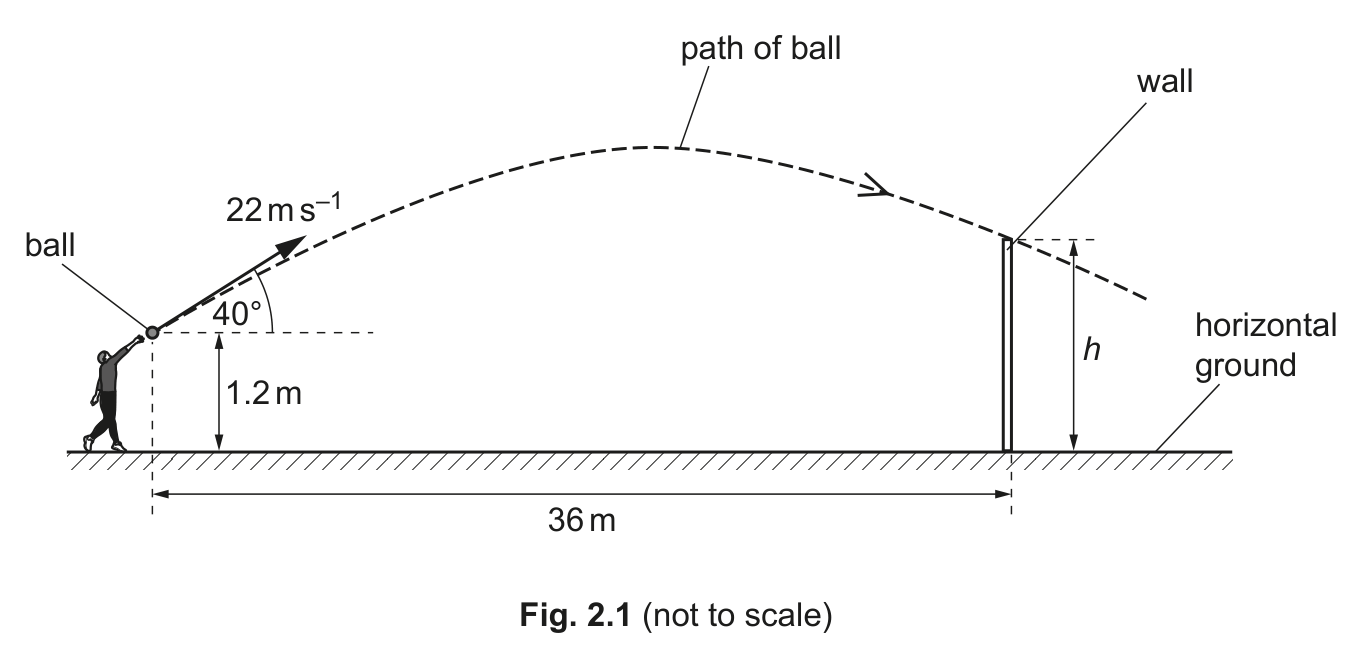
A student throws a ball over a vertical wall of height h, as shown in Fig. 2.1.
The ball leaves the hand of the student at a height of 1.2 m above the horizontal ground. The ball has an initial velocity of 22 m s⁻¹ at an angle of 40° to the horizontal. The wall is a horizontal distance of 36 m from where the student releases the ball. Air resistance is negligible.
(b)(i)Determine the time taken for the ball to reach the wall.
Answer guidance
Determine Work it out from what you are given or from the figure, and show how you got there.
[2 marks]
A student throws a ball with an initial velocity of 22 m s⁻¹ at an angle of 40° to the horizontal, from a height of 1.2 m above horizontal ground. Air resistance is negligible.
(b)(ii)Calculate the vertical component u of the initial velocity of the ball.
Answer guidance
Calculate Show your working. The method can earn marks even when the final value is wrong, and a bare answer often cannot.
[1 mark]
A student throws a ball over a vertical wall of height h. The ball leaves the hand of the student at a height of 1.2 m above the horizontal ground with an initial velocity of 22 m s⁻¹ at an angle of 40° to the horizontal. The wall is a horizontal distance of 36 m from where the student releases the ball. Air resistance is negligible. (The time to reach the wall was found in (b)(i) and the vertical component of initial velocity in (b)(ii).)
The ball just goes over the wall.
(b)(iii)Calculate the height h of the wall.
Answer guidance
Calculate Show your working. The method can earn marks even when the final value is wrong, and a bare answer often cannot.
[3 marks]
9702/21/M/J/24Cambridge International AS & A Level Physics 9702 · May/June 2024 · Paper 2 variant 1 · Question 2