A sinusoidal alternating potential difference (p.d.) from a supply is rectified using a single diode.
(a)(i)Determine the root-mean-square (r.m.s.) value of the supply potential difference before rectification.
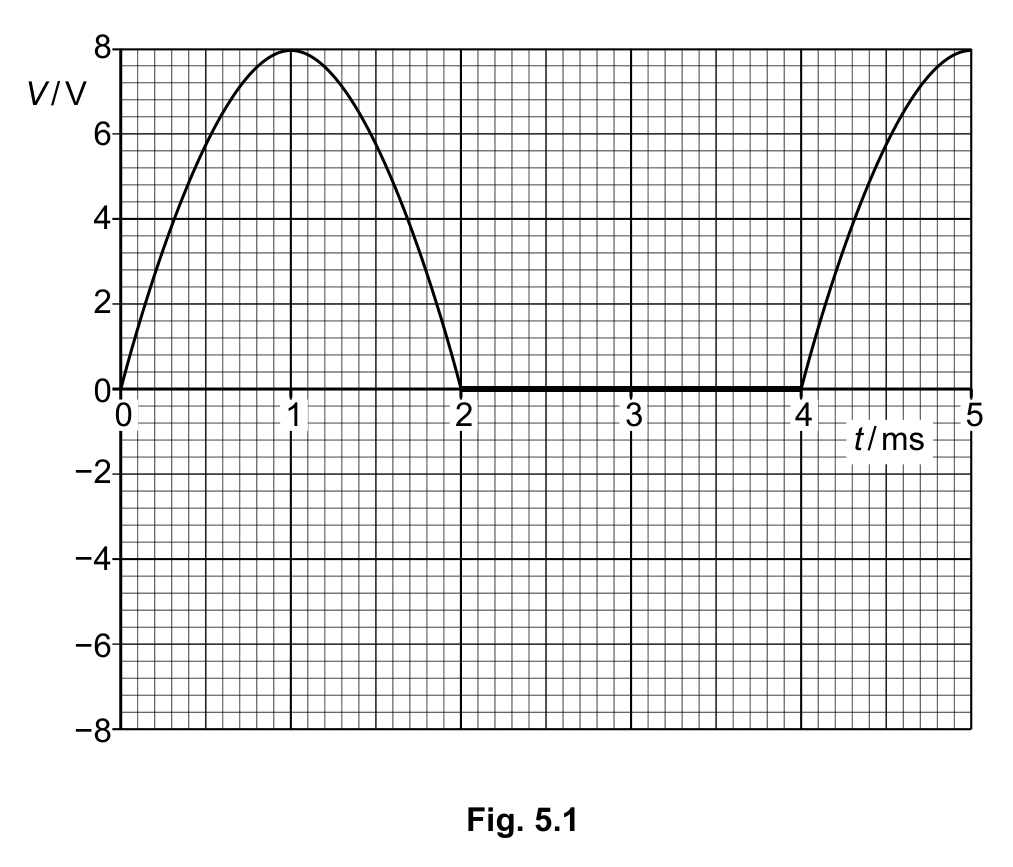
A sinusoidal alternating potential difference (p.d.) from a supply is rectified using a single diode.
(a)(i)Determine the root-mean-square (r.m.s.) value of the supply potential difference before rectification.
A sinusoidal alternating potential difference from a supply is rectified using a single diode.
(a)(ii)State the type of rectification shown in Fig. 5.1.
A sinusoidal alternating potential difference is rectified and smoothed using the circuit in Fig. 5.2. The capacitor has capacitance C of 85 μF and the resistor has resistance R. The effect of the capacitor and the resistor is to produce a smoothed output potential difference V_OUT. The difference between maximum and minimum values of V_OUT is 2.0 V.
(b)(i)On Fig. 5.1, draw a line to show V_OUT between times t = 1.0 ms and t = 5.0 ms.
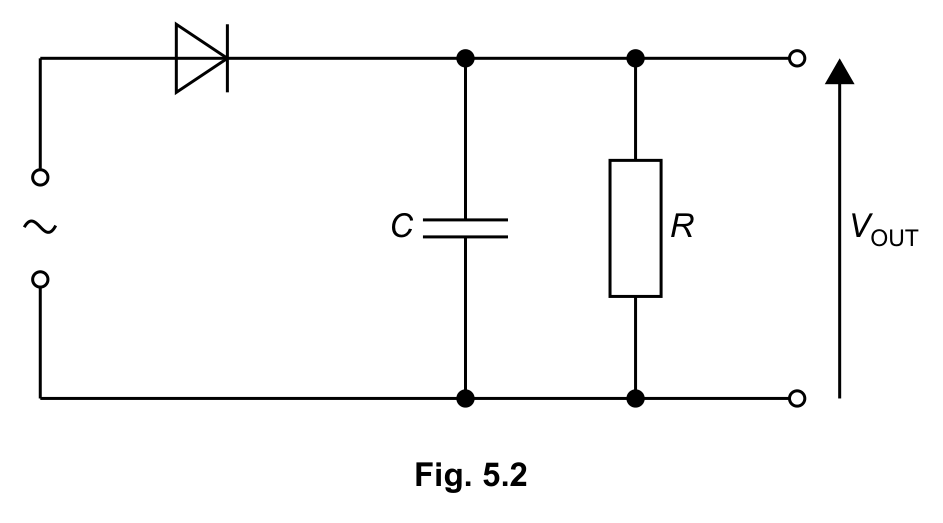
A sinusoidal alternating potential difference is rectified with a single diode and smoothed by a capacitor C = 85 μF in parallel with a resistor R, giving output V_OUT whose maximum and minimum values differ by 2.0 V.
(b)(ii)Determine the time, in s, for which the capacitor is discharging between times t = 1.0 ms and t = 5.0 ms.
(b)(iii)A rectified alternating p.d. is smoothed by a capacitor C = 85 μF in parallel with a resistor R; the difference between maximum and minimum values of V_OUT is 2.0 V, with peak value 8 V. Using your smoothed V_OUT line drawn on Fig. 5.1 and the discharging time found in (b)(ii), calculate the resistance R.
9702/04/SP/22Cambridge International AS & A Level Physics 9702 · Specimen 2022 · Paper 4 · Question 5