Available practice: 53 of 60 marks. Parts 2(b)(iv), 4(b)(iii), 6(b)(v) await marking support. Scores cover available parts only.
(a)Define acceleration.
[1 mark]
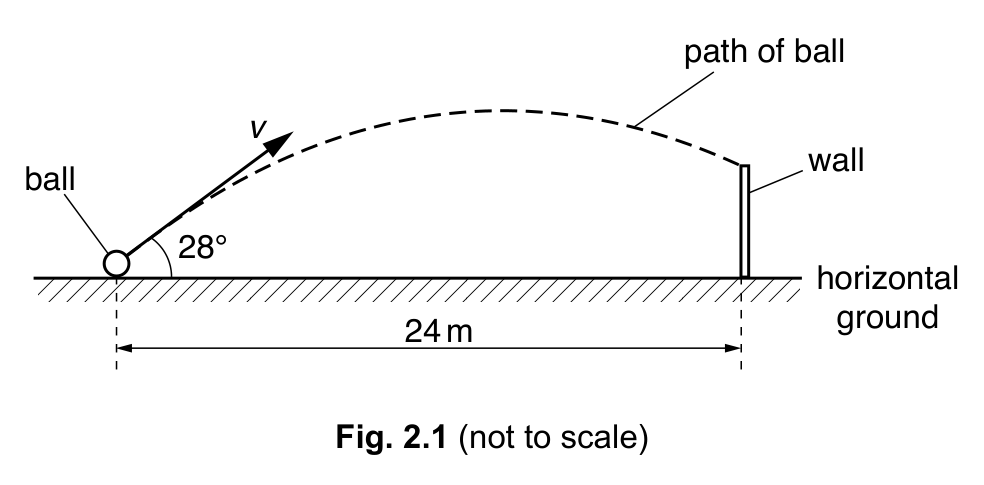
A ball is kicked from horizontal ground towards a vertical wall, as shown in Fig. 2.1.
The horizontal distance between the initial position of the ball and the base of the wall is 24 m. The ball is kicked with an initial velocity v at an angle of 28° to the horizontal. The ball hits the top of the wall after a time of 1.5 s. Air resistance is negligible.
(b)(i)Calculate the initial horizontal component vX of the velocity of the ball.
Answer guidance
Calculate Show your working. The method can earn marks even when the final value is wrong, and a bare answer often cannot.
[1 mark]
A ball is kicked from horizontal ground towards a vertical wall.
(b)(ii)Show that the initial vertical component vY of the velocity of the ball is 8.5 m s⁻¹.
Answer guidance
Show The result is given, so every step of the reasoning is what earns the marks.
[2 marks]
A ball is kicked from horizontal ground at an angle of 28° to the horizontal towards a vertical wall 24 m away; it hits the top of the wall after 1.5 s. Air resistance is negligible. The initial vertical component of velocity is 8.5 m s⁻¹.
(b)(iii)Calculate the time taken for the ball to reach its maximum height above the ground.
Answer guidance
Calculate Show your working. The method can earn marks even when the final value is wrong, and a bare answer often cannot.
[2 marks]
A ball is kicked from horizontal ground at 28° to the horizontal, with initial vertical component of velocity 8.5 m s⁻¹, and hits the top of a vertical wall 24 m away after 1.5 s. Air resistance is negligible.
(c)(i)Calculate the maximum height above the ground of the ball.
Answer guidance
Calculate Show your working. The method can earn marks even when the final value is wrong, and a bare answer often cannot.
[2 marks]
A ball kicked from horizontal ground with initial vertical component of velocity 8.5 m s⁻¹ reaches a maximum height above the ground (calculated in (c)(i)). The maximum gravitational potential energy of the ball above the ground is 22 J.
(c)(ii)Calculate the mass of the ball.
Answer guidance
Calculate Show your working. The method can earn marks even when the final value is wrong, and a bare answer often cannot.
[2 marks]
A ball of greater mass is kicked with the same velocity as the ball in (b) (kicked from horizontal ground at 28° to the horizontal). Air resistance is still negligible.
(d)State and explain the effect, if any, of the increased mass on the time taken by the ball to reach its maximum height.
Answer guidance
State A short answer. No explanation is needed, and adding one cannot earn extra marks.
[1 mark]
9702/02/SP/22Cambridge International AS & A Level Physics 9702 · Specimen 2022 · Paper 2 · Question 2