A student finds the volume of a small glass ball (marble) by two methods. Method 1: six similar glass balls are placed beside a metre rule with no gaps, as shown in Fig. 1.1.
(a)(i)Read from Fig. 1.1 the positions of A and B to the nearest 0.1 cm.
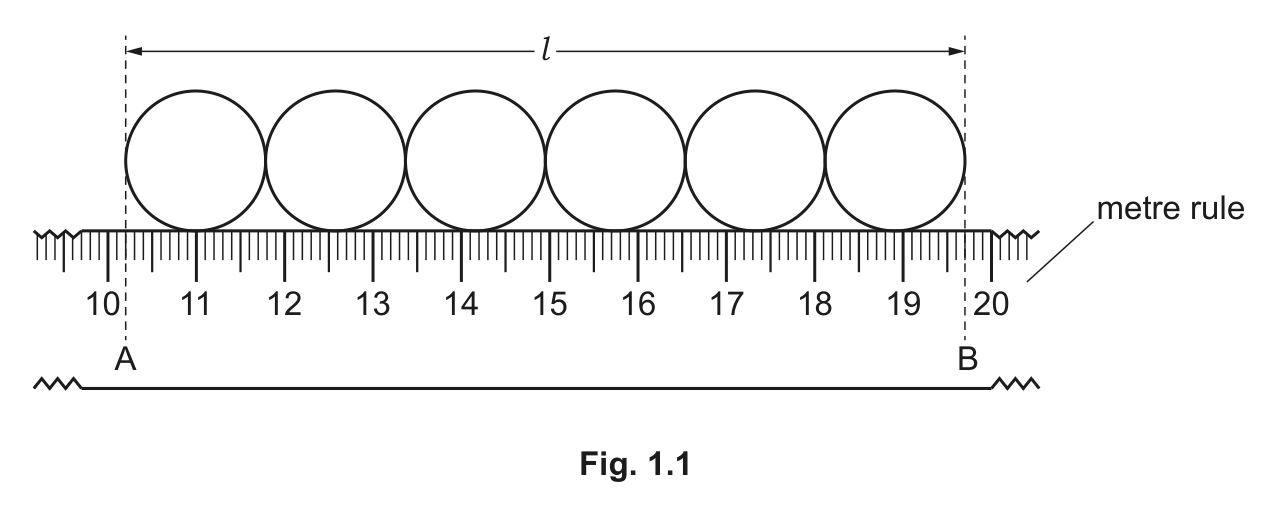
A student finds the volume of a small glass ball (marble) by two methods. Method 1: six similar glass balls are placed beside a metre rule with no gaps, as shown in Fig. 1.1.
(a)(i)Read from Fig. 1.1 the positions of A and B to the nearest 0.1 cm.
(a)(ii)Length l is the distance between A and B. The average diameter d satisfies l = 6d. Use your answers to (a)(i) to find l and d, both to the nearest 0.1 cm.
(a)(iii)Calculate the average volume V of one ball in cm³ using V = 3.14d³/6.
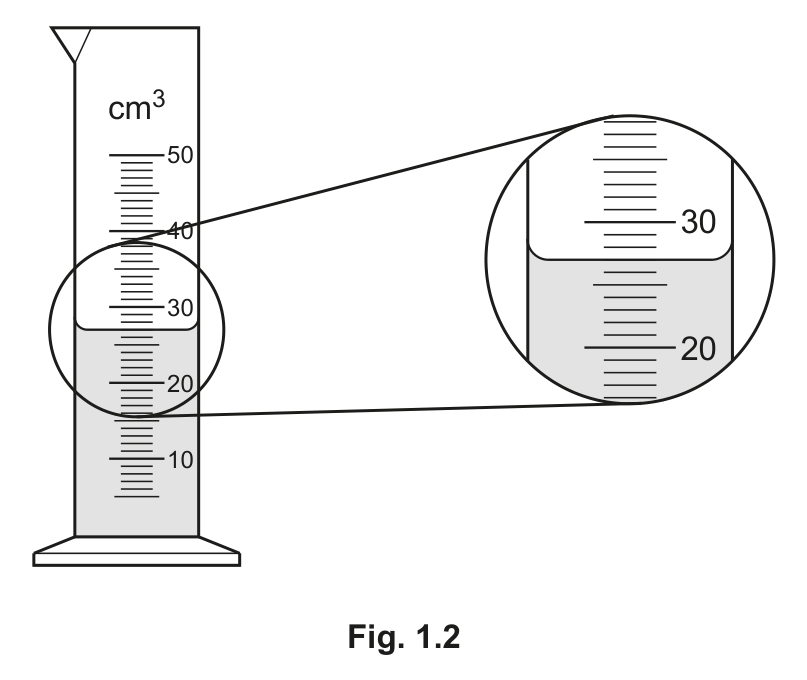
Method 2: the student pours water into a measuring cylinder.
(b)(i)Write down volume V₁ in cm³ shown in Fig. 1.2.
(b)(ii)After adding six balls, the new volume V₂ is shown in Fig. 1.3. Calculate their total volume Vₜ = V₂ − V₁ in cm³. Show working.
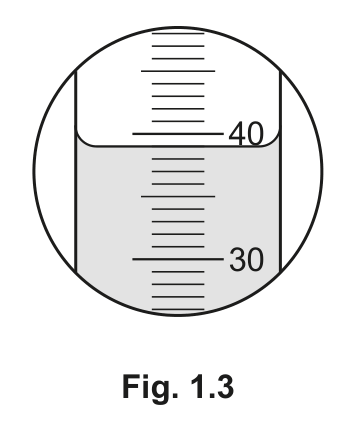
(b)(iii)Calculate the average volume V of one ball from method 2, to the nearest 0.1 cm³.
(c)Suggest which method gives the more accurate volume and explain why.
(d)Describe how the student uses the six glass balls, a small beaker and a top-pan electronic balance to find the average mass of one ball.
5054/41/M/J/24Cambridge O Level Physics 5054 · May/June 2024 · Paper 4 variant 1 · Question 1