2024 · M/J · 5054/31 | Q3

0/26parts marked · 0 of 40 marks
All questions
Question (3 of 4)14 marks · Practise this topic →
Options

Report Wrong question content

CIE-5054-2024-MJ-p31 · Question 3

Practical test: laboratory apparatus, supervision and your own measurements are required. Do not invent observations. Upload clear working and graphs with the readings used.

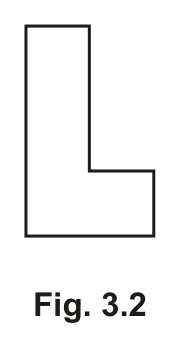
Find the focal length of a convex lens. Fig. 3.1 shows a lamp, illuminated object, lens and screen, with object–screen distance D. Place the screen at D = 60.0 cm. Starting with the lens close to the object, move it away until a clearly focused image forms. The apparatus is set up for you and includes a metre rule. Start with the lens about 10 cm from the object. Use your own observations. Fig. 3.2 shows the object shape.

(a)(i)Describe two differences between the illuminated object and its image.
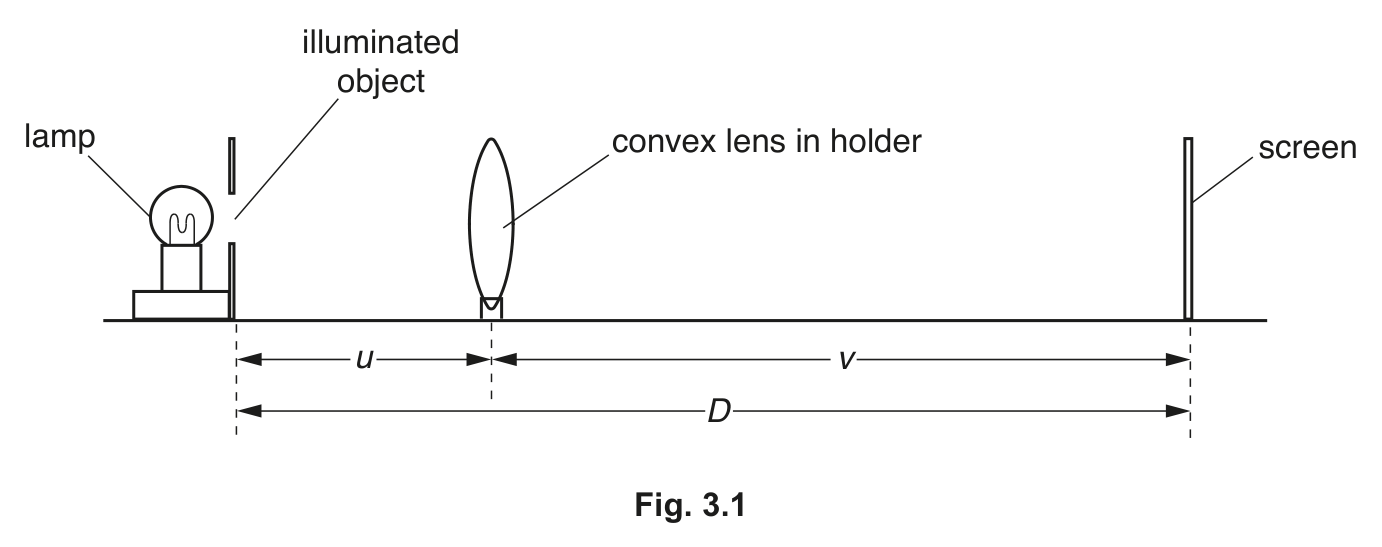
Fig. 3.1 — see the question text for what it shows
Fig. 3.2 — see the question text for what it shows
Answer guidance

Describe Say what happens, in order. Reasons are not required unless the question also asks why.

[2 marks]

This part can’t be checked automatically yet. Compare your own working with the explanation below.

Show explanationHide explanation

One correct answer. This part can’t be checked automatically yet, so compare your own working with it.

When the image on the screen is clearly focused, compare it with the illuminated object. The L shape is not symmetrical, so you can check whether it has turned upside down, whether it has been reversed left to right, and whether it is larger. Write two separate differences, one in each space.

The mark scheme accepts any two of these: the image is upside down (inverted); it is laterally inverted, so left and right are swapped; it is bigger than the object (magnified). Each one earns a mark. Describe the two you can see on your own screen, and do not add a statement that contradicts either of them.

Do similar questions
(a)(ii)For D = 60.0 cm, measure the distance u from the object to the centre of the lens. Record u to 0.1 cm in Table 3.1.

Answer guidance

Using You must use the thing it names. An answer that reaches the right value another way may not score.

[1 mark]

This part can’t be checked automatically, and its answer is your own measurement, so there is no explanation for it.

(a)(iii)Deduce distance v from the centre of the lens to the screen. Record it to 0.1 cm in Table 3.1.

Answer guidance

Identify Name it and, where the marks allow, say what led you there.

[1 mark]

This part can’t be checked automatically yet. Compare your own working with the explanation below.

Show explanationHide explanation

One correct answer. This part can’t be checked automatically yet, so compare your own working with it.

No new measurement is needed. Fig. 3.1 shows that the object-to-screen distance D is made up of u and v, so D = u + v. Rearranged, v = D − u. Use D = 60.0 cm and your own value of u from (a)(ii): v = 60.0 cm − u.

The mark scheme finds v as 60 minus your answer to (a)(ii), so check your subtraction. Record v in Table 3.1 to the nearest 0.1 cm, as the question asks, so that it has the same precision as u.

Do similar questions

Table 3.1 columns: D / cm, u / cm, v / cm, (u × v) / cm². Use D = 60.0, 70.0, 80.0, 90.0, 100.0 cm.

(a)(iv)Repeat the focusing procedure for each remaining value of D and record u and v.

Answer guidance

Using You must use the thing it names. An answer that reaches the right value another way may not score.

[1 mark]

This part can’t be checked automatically yet. Compare your own working with the explanation below.

Show explanationHide explanation

One correct answer. This part can’t be checked automatically yet, so compare your own working with it.

Repeat the same procedure for D = 70.0, 80.0, 90.0 and 100.0 cm. Each time, place the screen at that distance from the illuminated object, start with the lens about 10 cm from the object, and move it slowly away until a clearly focused image first forms. Measure u from the object to the centre of the lens, then find v = D − u, both to 0.1 cm.

Record u and v for every value of D; the mark needs the whole table filled in. It also needs the pattern the scheme looks for: as D increases, u should get smaller and v larger, all the way down the table. If one row breaks that pattern, check it by refocusing from the object end and measuring again.

Do similar questions

(a)(v)Calculate u × v for each D and record the products to 3 significant figures.

Answer guidance

Calculate Show your working. The method can earn marks even when the final value is wrong, and a bare answer often cannot.

[2 marks]

This part can’t be checked automatically yet. Compare your own working with the explanation below.

Show explanationHide explanation

One correct answer. This part can’t be checked automatically yet, so compare your own working with it.

For each row of Table 3.1, multiply your own u by your own v, using the values exactly as you recorded them, and write the product in the (u × v) / cm² column. Do this for all five values of D: one mark is for calculating the product for every D.

The second mark is for every product being correct to 3 significant figures. Keep three significant digits, rounding the third using the digit after it: a product in the hundreds is written to the nearest whole number, one in the thousands to the nearest ten, with a zero holding the last place. The unit, cm², is already in the column heading, so write only the numbers.

Do similar questions

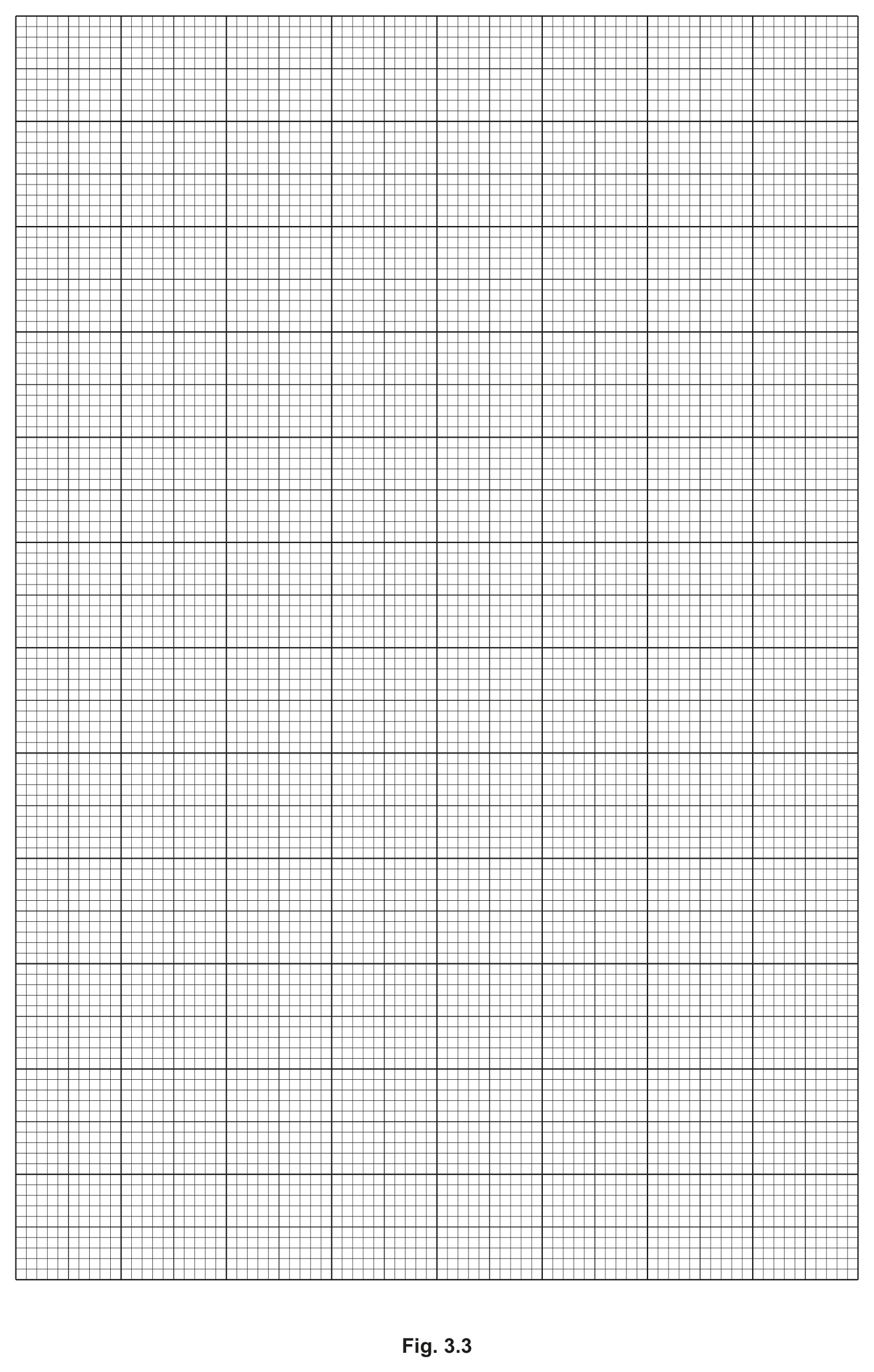
(b)On Fig. 3.3 plot (u × v) / cm² on the y-axis against D / cm on the x-axis. You need not start at (0,0). Draw the straight line of best fit.

Fig. 3.3 — see the question text for what it shows
Answer guidance

Draw Accuracy is being marked. Use the figure and be precise about position and labels.

[4 marks]

This part can’t be checked automatically yet. Compare your own working with the explanation below.

Show explanationHide explanation

One correct answer. This part can’t be checked automatically yet, so compare your own working with it.

Plot (u × v) / cm² on the y-axis and D / cm on the x-axis, and label each axis with both the quantity and its unit, as in the table headings. One mark is for these labels.

One mark is for the scales. Make them linear, with equal steps along each axis and each square worth a simple amount such as 1, 2 or 5 units (or 10, 20, 50), never an awkward value such as 3 or 7. The scheme says the scales should not start from (0,0): begin each axis at a convenient round number a little below your smallest value, so every grid line has a simple value.

Plot all five points from your table, each within half a small square of its true position, using small neat crosses or dots. Finally, draw one thin straight line of best fit with a ruler. It need not pass through every point, but the points should be balanced on either side of it. These earn the last two marks.

Do similar questions

(c)The focal length f is numerically equal to the gradient of your line. Calculate the gradient, showing all working and indicating on Fig. 3.3 the values you use. Give f in cm.

Answer guidance

Calculate Show your working. The method can earn marks even when the final value is wrong, and a bare answer often cannot.

[2 marks]

This part can’t be checked automatically yet. Compare your own working with the explanation below.

Show explanationHide explanation

One correct answer. This part can’t be checked automatically yet, so compare your own working with it.

Choose two points on your best-fit line that are far apart and mark them clearly on Fig. 3.3, for example as the corners of a large triangle drawn on the line. Read their coordinates from the line, not from your table. One mark needs these values shown on the graph and covering at least half of your line, with a change in D of at least 20 cm.

Then calculate the gradient = change in (u × v) ÷ change in D = (y2 − y1) ÷ (x2 − x1), writing both differences and the division so the full working is shown. The units give cm² ÷ cm = cm, so the gradient is f in cm. The second mark is for f calculated correctly from your own graph with this working.

Do similar questions

(d)The manufacturer states f = 15.0 cm ± 10%. Decide, with a calculation, whether your f agrees. State either “agrees” or “does not agree”.

Answer guidance

Using You must use the thing it names. An answer that reaches the right value another way may not score.

[1 mark]

This part can’t be checked automatically yet. Compare your own working with the explanation below.

Show explanationHide explanation

One correct answer. This part can’t be checked automatically yet, so compare your own working with it.

First find the range the manufacturer allows. 10% of 15.0 cm is 0.10 × 15.0 = 1.5 cm, so the stated focal length runs from 15.0 − 1.5 = 13.5 cm to 15.0 + 1.5 = 16.5 cm.

Compare your own f from (c) with this range, and show the comparison as your calculation. Or work out the percentage difference, (your f − 15.0) ÷ 15.0 × 100%, ignoring any minus sign, and see whether it is no more than 10%.

Tick “agrees” if your f lies inside the range and “does not agree” if it lies outside. The mark needs both the calculation and a decision that matches it, so a tick on its own does not score.

Do similar questions

5054/31/M/J/24Cambridge O Level Physics 5054 · May/June 2024 · Paper 3 variant 1 · Question 3