(a)(i)State which two nuclei have the same number of protons.
2024 · M/J · 5054/21 | Q7
Options
(a)(ii)State which two nuclei have the same number of neutrons.
(a)(iii)State which two nuclei have the same number of nucleons.
A teacher uses a Geiger-Müller tube and a counter to measure the background radiation in the laboratory. The counter records 20 counts per minute.
(b)(i)State what is meant by 'background radiation'.
A Geiger-Müller tube and counter record 20 counts per minute of background radiation in a laboratory. A radioactive source is then placed in front of the tube and the counter records 420 counts per minute.
The measured count rate of 420 counts per minute can be corrected for background radiation.
(b)(ii)Calculate the corrected count rate from the source.
A Geiger-Müller counter records 420 counts per minute with a radioactive source present; the background count rate is 20 counts per minute, so the corrected count rate from the source is 400 counts per minute.
The radioactive source has a half-life of 45 minutes.
(b)(iii)Determine the reading on the counter 90 minutes later.
A radioactive source with a half-life of 45 minutes gives a counter reading which is predicted 90 minutes later.
(b)(iv)Suggest why your answer to (iii) is only an estimate.
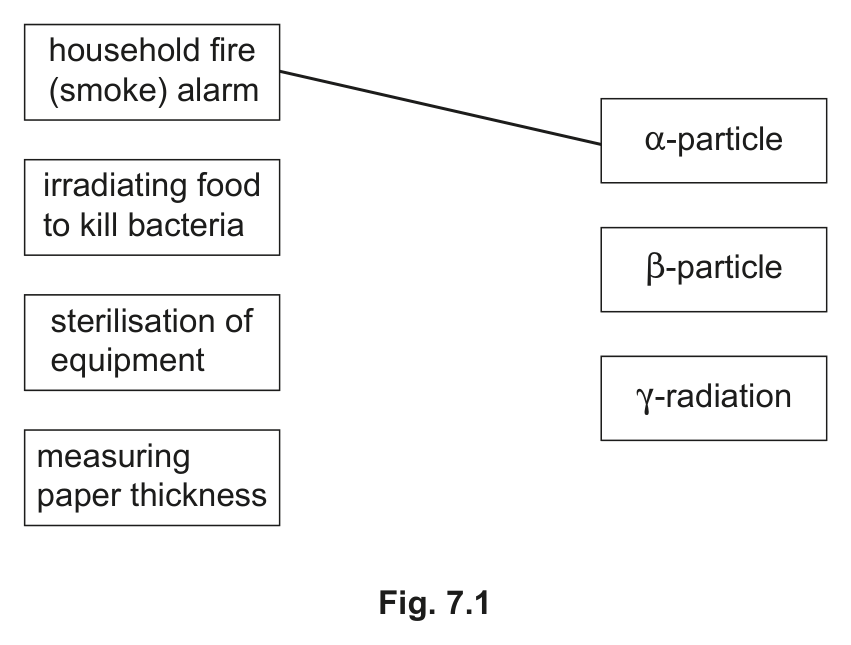
Draw a line on Fig. 7.1 from each use of radiation to the type of radiation used. One line has been drawn for you.
(c)Each type of radiation can be used once, more than once or not at all.
5054/21/M/J/24Cambridge O Level Physics 5054 · May/June 2024 · Paper 2 variant 1 · Question 7