(a)Complete Fig. 5.1 by drawing the symbol for a fuse in the gap in the circuit.
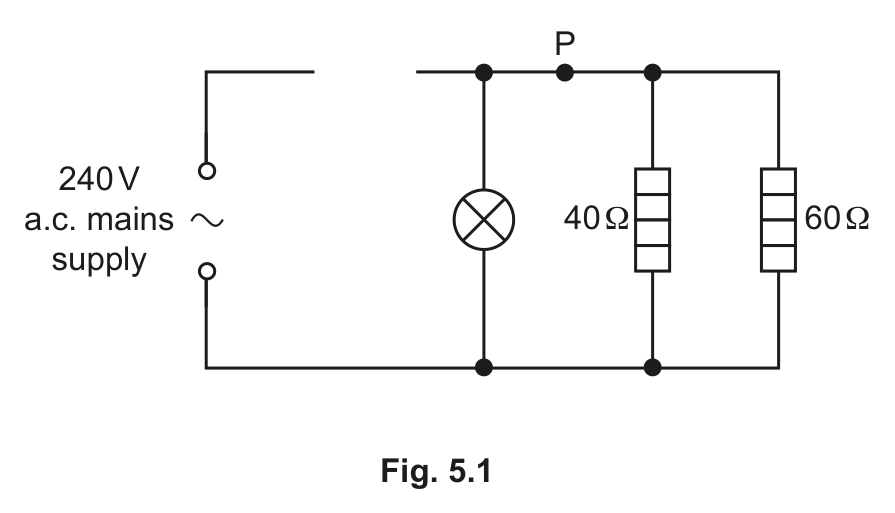
(a)Complete Fig. 5.1 by drawing the symbol for a fuse in the gap in the circuit.
(b)(i)On Fig. 5.2 sketch a current−voltage graph for a filament lamp.
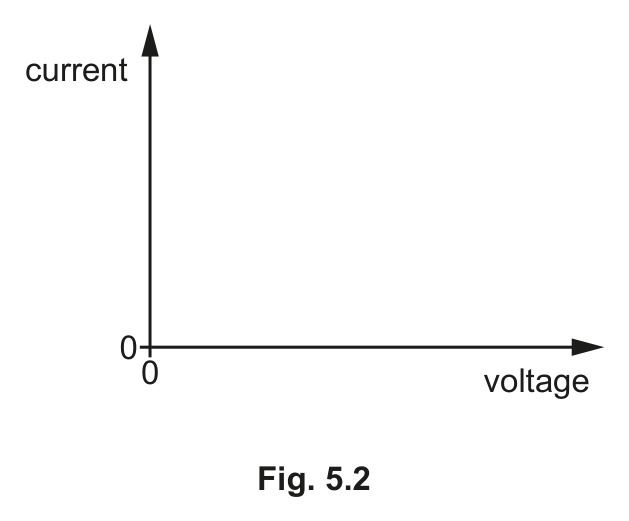
A current−voltage graph is sketched for a filament lamp.
(b)(ii)Explain the shape of the current−voltage graph drawn in (i).
(c)Calculate the current at point P in the circuit shown in Fig. 5.1.
In the circuit of Fig. 5.1, a 240 V mains supply is connected through a fuse to a lamp and two heaters of resistance 40 Ω and 60 Ω in parallel. The current in the lamp is 1.5 A (the heaters take 6.0 A and 4.0 A respectively).
(d)(i)Suggest a suitable fuse rating for the fuse.
A fuse is fitted in a mains circuit supplying a lamp and two heaters, where the total current is about 11.5 A.
(d)(ii)Explain why a fuse rating much larger than the value suggested in (i) is not suitable.
(d)(iii)Explain why it is necessary to connect a fuse in the live wire rather than the neutral wire or earth wire.
5054/21/M/J/24Cambridge O Level Physics 5054 · May/June 2024 · Paper 2 variant 1 · Question 5