2023 · Specimen · 5054/03 | Q2

0/21parts marked · 0 of 40 marks
All questions
Question (2 of 4)10 marks · Practise this topic →
Options

Report Wrong question content

CIE-5054-2023-SP-p03 · Question 2

Practical test: laboratory apparatus, supervision and your own measurements are required. Do not invent observations. Upload clear working and graphs with the readings used.

Investigate how two lenses affect the size of a shadow. Fig. 2.1 shows a lamp connected to a power supply, a clamped lens, graph paper, a stand, weight, clamps and bosses. You also have a second lens, a small circular piece of adhesive putty and a metre rule. Use your own laboratory observations.

(a)Describe two precautions to ensure the apparatus is set up safely.
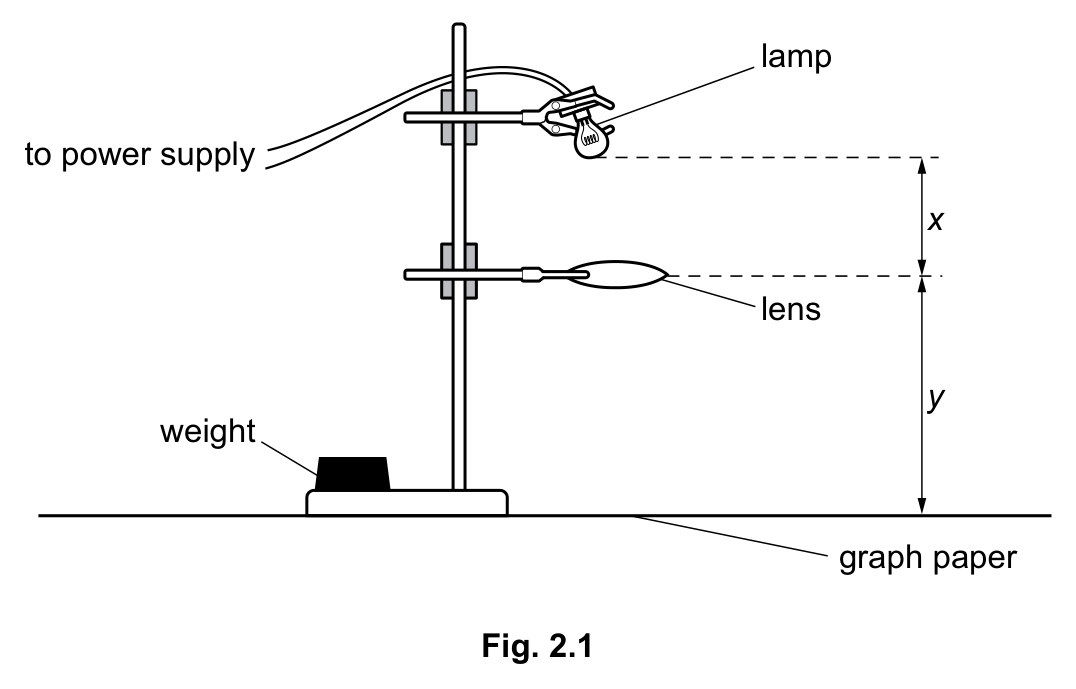
Fig. 2.1 — see the question text for what it shows
Answer guidance

Describe Say what happens, in order. Reasons are not required unless the question also asks why.

[2 marks]

This part can’t be checked automatically yet. Compare your own working with the explanation below.

Show explanationHide explanation

One correct answer. This part can’t be checked automatically yet, so compare your own working with it.

Give two different precautions, each a specific action taken with this apparatus. Accepted ideas include a weight on the base so the stand cannot topple, and a supply voltage that does not exceed the lamp's rating.

Others accepted: the lens clamped securely, because glass can break; the apparatus kept away from the edge of the bench; the leads to the supply pushed out of the way; and the lamp and lens clamped so that their moment about the stand base is small, which reduces the risk of toppling.

Do similar questions
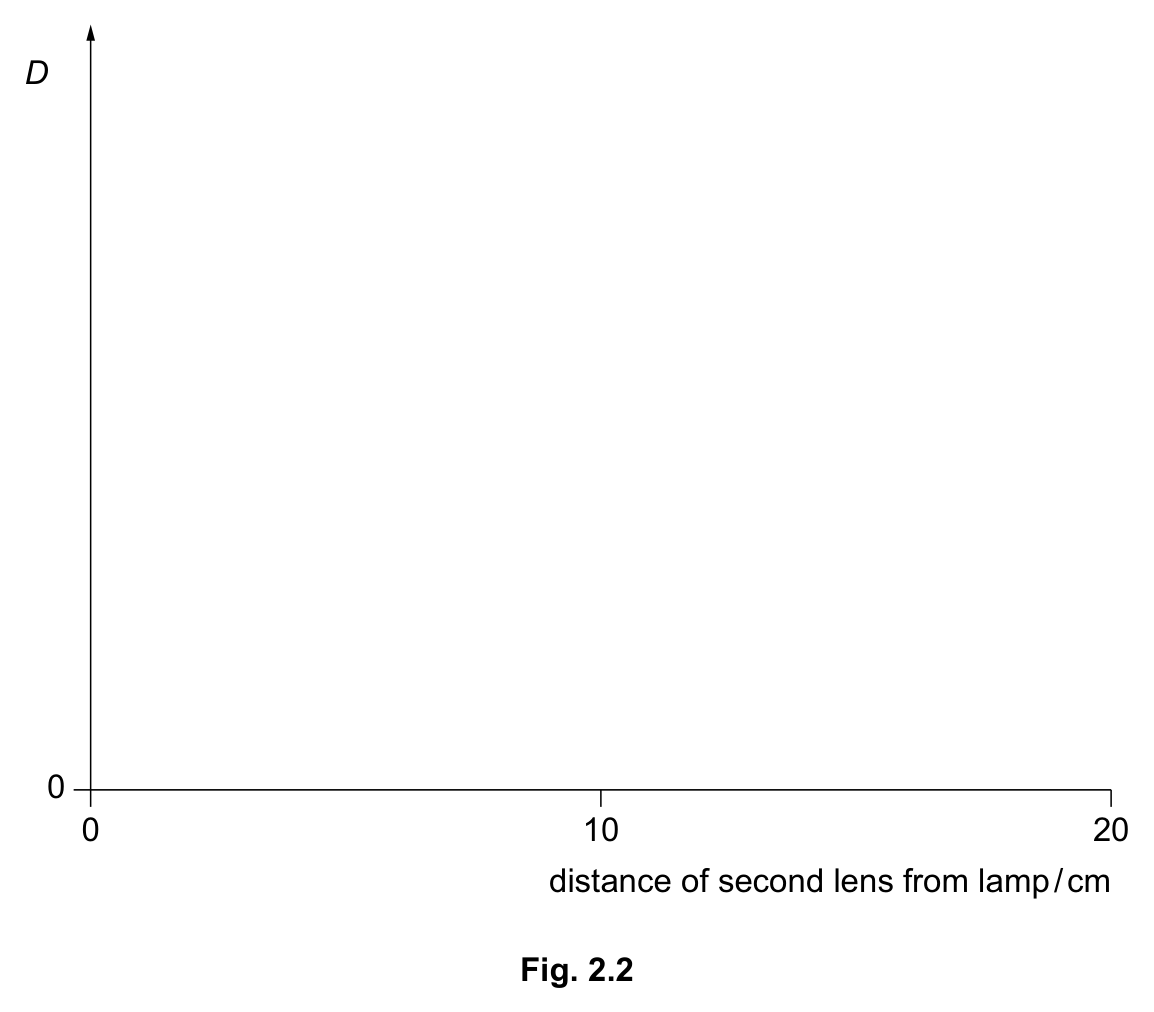
(b)Set distance x to approximately 20 cm. Switch on the lamp and place the putty at the centre of the clamped lens. Hold the second lens touching the lamp, then move it down towards the clamped lens. On Fig. 2.2 sketch how the shadow diameter D changes as the second lens moves from x = 0 cm to x = 20 cm.

Fig. 2.2 — see the question text for what it shows
Answer guidance

Using You must use the thing it names. An answer that reaches the right value another way may not score.

[2 marks]

This part can’t be checked automatically yet. Compare your own working with the explanation below.

Show explanationHide explanation

One correct answer. This part can’t be checked automatically yet, so compare your own working with it.

Watch the putty's shadow the whole time as you lower the second lens from the lamp (x = 0 cm) to the clamped lens (x = 20 cm). Note whether D shrinks or grows, the position where the shadow disappears, and how big it is at the end compared with the start.

Sketch D against the distance of the second lens from the lamp; no plotted points are needed. Start at the shadow size you saw at x = 0. The scheme credits a line that falls (negative gradient) to D = 0, then rises (positive gradient), ending at x = 20 cm with a larger D than at x = 0. Put the zero at the distance where you saw the shadow vanish.

Do similar questions

(c)(i)Remove the putty and adjust the clamped lens until the image of the lamp on the graph paper is as small and bright as possible. It may not be in focus. Measure x from the centre of the lens to the centre of the lamp and y from the bench to the centre of the lens. Record x and y in cm.

Answer guidance

Using You must use the thing it names. An answer that reaches the right value another way may not score.

[2 marks]

This part can’t be checked automatically yet. Compare your own working with the explanation below.

Show explanationHide explanation

One correct answer. This part can’t be checked automatically yet, so compare your own working with it.

Adjust the clamped lens until the patch of light on the graph paper is as small and bright as you can make it, even if it is not sharp. Then use the metre rule to measure x from the centre of the lens to the centre of the lamp, and y from the bench to the centre of the lens.

Hold the rule vertical and read the scale with your eye level with the point being measured. The marks are for both measurements and for giving them to the nearest mm, so write each in cm to one decimal place, including a final zero if needed.

Do similar questions

(c)(ii)A student suggests f = xy/(x + y), where x and y are determined for a focused image. Calculate f in cm using your values from (c)(i). Show your working.

Answer guidance

Show The result is given, so every step of the reasoning is what earns the marks.

[2 marks]

This part can’t be checked automatically yet. Compare your own working with the explanation below.

Show explanationHide explanation

One correct answer. This part can’t be checked automatically yet, so compare your own working with it.

Substitute your own x and y from (c)(i) into f = xy/(x + y), and show the substitution with your numbers: multiply x by y for the top line, add x and y for the bottom line, then divide. One mark is for this correct substitution.

Because xy is in cm² and x + y is in cm, f comes out in cm. Give it to 2 or 3 significant figures. The second mark is for an answer in the range the examiners expect from this apparatus, so it rewards careful positioning and measuring in (c)(i) and accurate arithmetic.

Do similar questions

(d)(i)State why this arrangement cannot accurately determine the focal length of the clamped lens.

Answer guidance

Using You must use the thing it names. An answer that reaches the right value another way may not score.

[1 mark]

This part can’t be checked automatically yet. Compare your own working with the explanation below.

Show explanationHide explanation

One correct answer. This part can’t be checked automatically yet, so compare your own working with it.

The equation f = xy/(x + y) applies only to a focused image, and (c)(i) warned that your smallest, brightest image may not be in focus. Give the reason: with this arrangement you cannot get a sharp image, because the lamp and the paper are too close together for the lens to focus the lamp onto the paper. They need to be further apart.

Do similar questions

(d)(ii)Suggest how to change the arrangement to determine the focal length accurately.

Answer guidance

Suggest More than one answer may be acceptable, so long as it is consistent with the physics.

[1 mark]

This part can’t be checked automatically yet. Compare your own working with the explanation below.

Show explanationHide explanation

One correct answer. This part can’t be checked automatically yet, so compare your own working with it.

Suggest a practical change that increases the distance between the lamp and the paper, so that a sharp image can form and x and y can be measured for it. Say how you would do it, for example by using a longer stand rod so the lamp can be clamped higher, or by raising the stand.

Do similar questions

5054/03/SP/23Cambridge O Level Physics 5054 · Specimen 2023 · Paper 3 · Question 2