The lens in a magnifying glass is a converging lens.
(a)(i)State what is meant by 'focal point'.
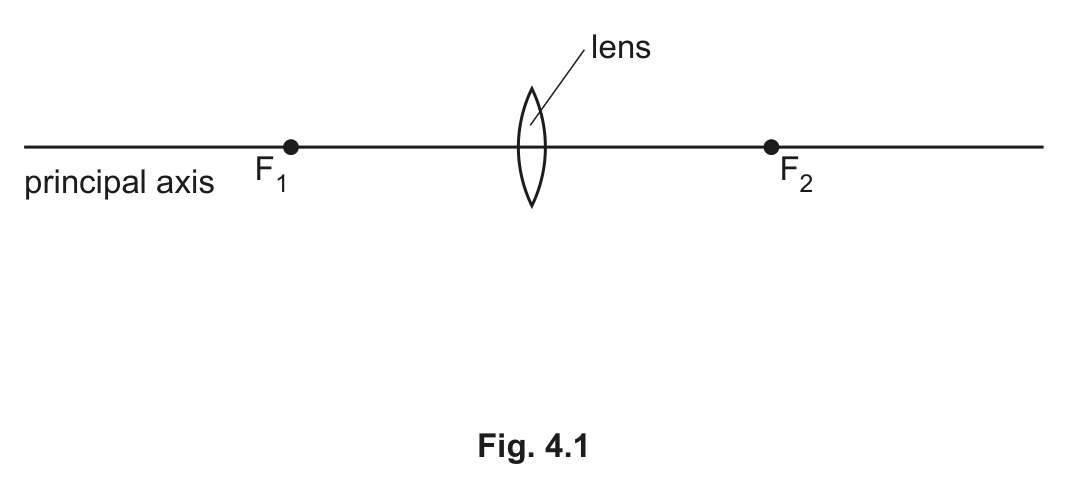
The lens in a magnifying glass is a converging lens.
(a)(i)State what is meant by 'focal point'.
A student using the magnifying glass sees a magnified image of an object.
On Fig. 4.1, mark:
• a point X on the principal axis for a possible position of the object
(a)(ii)• a point E for a possible position of the student's eye.
A student using a magnifying glass (converging lens) sees a magnified image of an object placed between the lens and its focal point.
Underline two words in the list that describe the image produced.
(a)(iii)inverted real upright virtual
The refractive index of the glass used to make a lens is 1.5.
(b)(ii)State what happens to the wavelength of light as it passes into the lens.
Converging lenses are used in spectacles (glasses) to correct one problem with vision.
(c)State the name of the problem and explain how a converging lens is used to correct it. You may draw a diagram.
0625/41/M/J/24Cambridge IGCSE Physics 0625 · May/June 2024 · Paper 4 variant 1 · Question 4