(a)State one way in which the motion of the particles in ice differs from the motion of the particles in water.
(a)State one way in which the motion of the particles in ice differs from the motion of the particles in water.
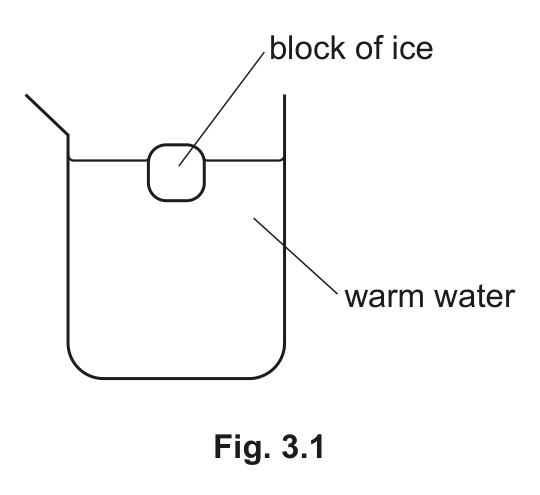
A small block of ice floats in a beaker of warm water. Energy is transferred from the water to the block of ice.
(b)(i)State the name of the thermal process that transfers energy from the water to the ice.
A small block of ice floats in a beaker of warm water. The temperature of the water near the ice decreases first.
(b)(iii)Explain how convection causes the temperature of all the water in the beaker to decrease.
0625/41/M/J/24Cambridge IGCSE Physics 0625 · May/June 2024 · Paper 4 variant 1 · Question 3