A piece of metal has an irregular shape. The weight of the metal is 3.0 N.
(a)Calculate the mass of the metal. (Take the weight of 1.0 kg to be 9.8 N.)
A piece of metal has an irregular shape. The weight of the metal is 3.0 N.
(a)Calculate the mass of the metal. (Take the weight of 1.0 kg to be 9.8 N.)
A piece of metal has an irregular shape. Fig. 2.1 shows the piece of metal, a measuring cylinder and a beaker containing water.
(b)(i)Describe how to determine the volume of the piece of metal, using the equipment in Fig. 2.1.
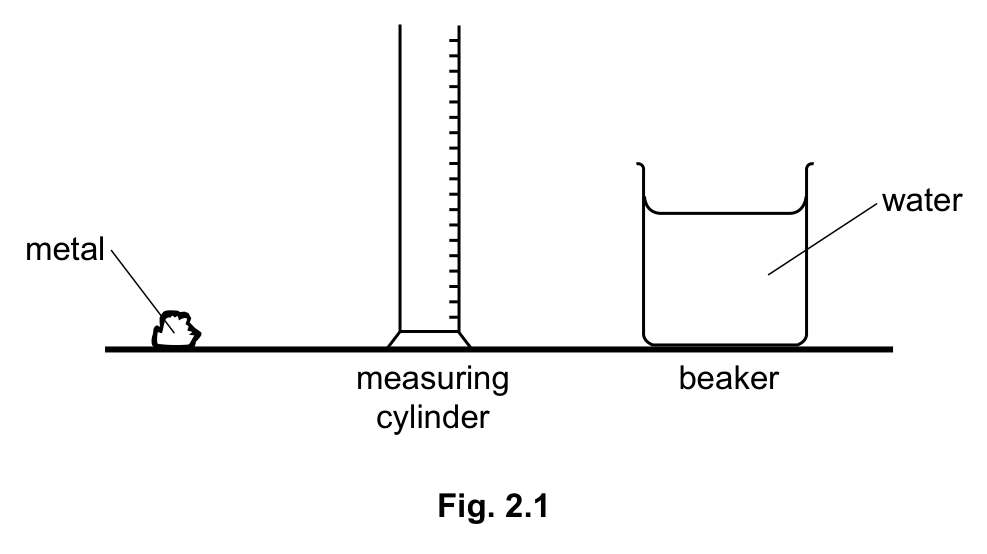
A method of finding the volume of an irregularly shaped piece of metal uses a measuring cylinder and a beaker of water (displacement of water).
(b)(ii)Explain why this procedure is not suitable for finding the volume of a piece of low-density wood that is a similar shape and size to the piece of metal.
The mass of another piece of metal is 405 g and its volume is 150 cm³.
(b)(iii)Calculate the density of this piece of metal, in g/cm³.
0625/03/SP/23Cambridge IGCSE Physics 0625 · Specimen 2023 · Paper 3 · Question 2